Emergency rooms operate around the clock, and imaging demand does not slow down just because the daytime radiology schedule has ended.
A patient may arrive late at night with a suspected fracture, chest pain, shortness of breath, or another condition that requires imaging. Whether the facility is a hospital-affiliated emergency department or a freestanding emergency room, the care team needs dependable access to radiology interpretation without creating delays or unnecessary backlogs.
That is where emergency room X-ray overread and teleradiology services can become an important part of the imaging workflow.
Why After-Hours Emergency Radiology Coverage Matters
Emergency imaging volume can change quickly. Nights, weekends, holidays, trauma cases, respiratory illness, local events, and unexpected surges can all increase demand.
The broader radiology environment is also under pressure. In September 2026, the American College of Radiology noted that imaging utilization continues to grow and that simply asking radiologists to interpret more studies faster is reaching practical limits.
For emergency departments, that makes dependable access to interpreting physicians increasingly important. Remote radiology can provide additional capacity without requiring every facility to maintain full onsite radiology staffing around the clock.
What Is an X-Ray Overread Service?
An X-ray overread service provides physician interpretation of imaging performed at another clinical location. In emergency settings, the model can be structured in several ways.
A facility may need final reads for all X-rays performed overnight. Another may use remote radiology only during certain shifts. A hospital system may rely on teleradiology to support multiple emergency departments, while a freestanding emergency room may use remote coverage as a core part of its imaging model.
The right setup depends on operating hours, modality mix, staffing, volume, and clinical needs. The goal is to create a dependable path from image acquisition to radiologist interpretation, report delivery, and communication back to the treating team.
Coverage Should Match the Reality of Emergency Care
Emergency departments cannot rely on a traditional 9-to-5 radiology model. Imaging demand continues through evenings, overnight shifts, weekends, and holidays.
Vesta Teleradiology provides 24/7 nationwide teleradiology coverage, giving emergency departments access to U.S. board-certified radiologists during nights, weekends, holidays, and periods of increased demand.
That flexibility can be especially useful for health systems with multiple emergency departments as well as freestanding emergency rooms that need dependable interpretation without maintaining a full onsite radiology team at every location.
Multi-Site Emergency Coverage Requires Consistency
Hospital systems may operate several emergency departments across a region, while freestanding emergency room groups may manage multiple locations with different staffing and imaging volumes.
Without a centralized reading strategy, each site can develop its own process for routing studies, receiving reports, and handling communication.
A teleradiology model can help standardize those steps across locations. That may include:
- Consistent report delivery
- Centralized access to radiologists
- Defined turnaround expectations
- Standard escalation procedures
- Coverage across multiple emergency locations
- Flexible reading capacity during volume spikes
Consistency becomes increasingly important as emergency networks grow.
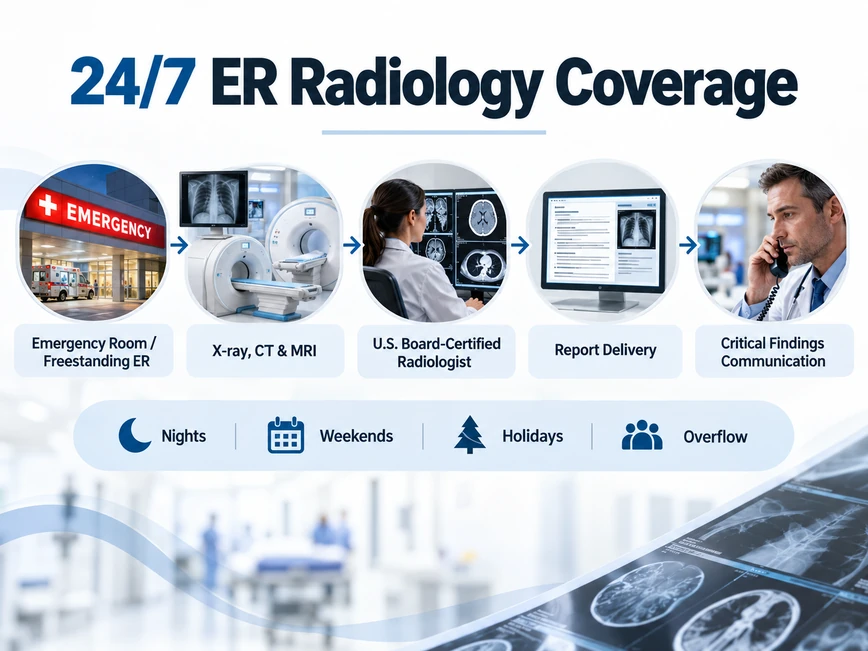
Workflow Integration Matters Just as Much as Coverage
The interpretation itself is only one part of the process. Images need to move reliably from the emergency department to the radiologist, and reports need to return to the appropriate clinical system without creating another disconnected workflow.
Federal health IT initiatives continue to emphasize this issue. In its 2026 standards bulletin, the Office of the National Coordinator for Health Information Technology highlighted the importance of exchanging imaging references so clinicians can access relevant imaging and connect clinical systems with studies stored in PACS environments.
For emergency departments, the practical takeaway is straightforward: remote radiology should fit into the existing imaging and reporting workflow rather than create additional steps for clinical staff.
What About More Complex or Critical Findings?
Emergency imaging frequently involves findings that may require timely communication back to the treating team.
A fracture, pneumothorax, pneumonia, intracranial abnormality, bowel obstruction, or other clinically significant finding may need more than routine report delivery.
That is why emergency departments should evaluate more than turnaround time. They should also ask:
- How are critical and important findings communicated?
- Who is contacted after normal business hours?
- What happens when an emergency physician needs to speak directly with the radiologist?
- How are reports returned to the facility?
- Can coverage scale when emergency imaging volume increases?
Those answers help determine whether the service truly supports emergency care rather than simply generating reports.
A Flexible Option for Freestanding and Hospital-Affiliated Emergency Rooms
Not every emergency department needs the same coverage model. Some facilities need overnight support. Others need full-time interpretation, weekend and holiday coverage, overflow capacity, backup coverage, or access to additional subspecialty expertise.
A flexible model allows radiology support to match the actual workload.
Vesta Teleradiology provides 24/7 nationwide coverage, Nighthawk services, overflow support, and subspecialty radiology services from U.S. board-certified radiologists, with workflows tailored to the needs of both hospital-affiliated emergency departments and freestanding emergency rooms.
Frequently Asked Questions
What is an emergency room X-ray overread?
An X-ray overread is a physician interpretation of an imaging study performed in an emergency department or freestanding emergency room. Depending on the coverage model, the radiologist may provide a final interpretation or another agreed-upon form of reporting.
Can teleradiology cover emergency departments overnight?
Yes. Teleradiology can be structured to provide overnight, weekend, holiday, overflow, backup, or continuous 24/7 coverage depending on the facility’s needs.
Can one teleradiology provider support multiple emergency room locations?
Yes. A centralized reading model can support multiple hospital-affiliated or freestanding emergency locations while helping standardize reporting, communication, and coverage procedures across the organization.
Can teleradiology support more than X-rays in the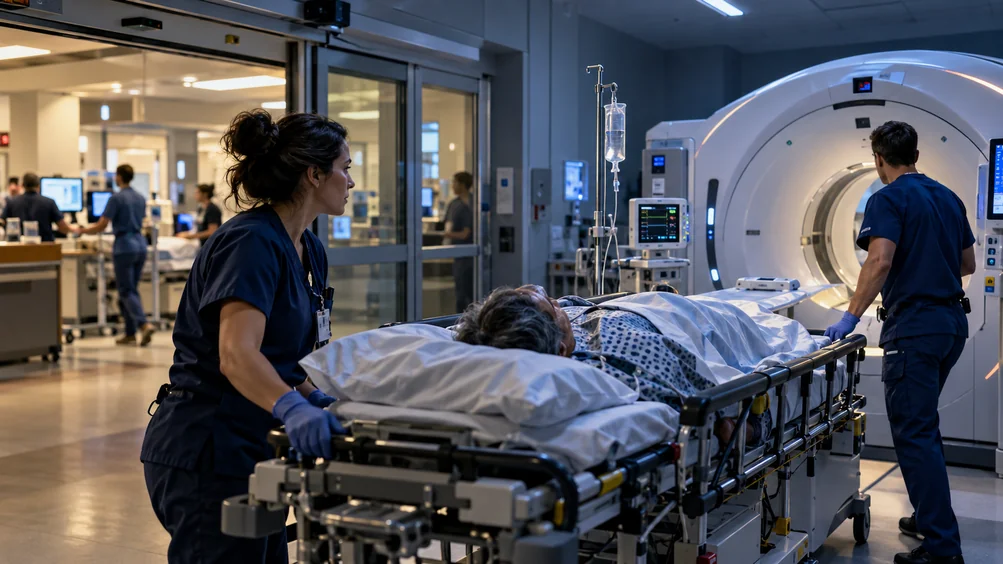 emergency department?
Yes. Depending on the facility’s coverage model, teleradiology can support CT, MRI, X-ray, and other imaging modalities as well as access to subspecialty interpretation.
Need dependable radiology coverage for your emergency department or freestanding ER? Contact Vesta Teleradiology to discuss 24/7, Nighthawk, overflow, and customized radiology support.