
The quiet risk hospitals don’t plan for: capacity collapse
Radiology coverage doesn’t always fail with a formal termination or an obvious “we’re done” message. More often, it erodes. A radiology group loses key radiologists, experiences unexpected attrition, can’t recruit fast enough, or faces scheduling strain that turns into missed commitments. The hospital still has the same ED demand, the same inpatient needs, and the same responsibility to keep care moving—yet turnaround times slip, subspecialty availability narrows, and internal teams get stretched thin.
From an operational standpoint, the impact can look like an “implosion,” even if the root cause is simply capacity mismatch.
What capacity loss looks like in real hospital workflows
When a radiology group is underwater, the warning signs typically show up as workflow symptoms before anyone names the problem:
- Growing backlogs during evenings, nights, or weekends
- Longer final-report turnaround times, especially for CT and MR
- Reduced subspecialty coverage (neuro, MSK, body, breast)
- More “wet reads,” delayed overreads, or inconsistent staffing patterns
- Slower critical result communication and more escalations to leadership
- Increasing reliance on a small number of radiologists to “save the shift”
None of these are just radiology issues. They affect ED throughput, length of stay, patient satisfaction, and clinician trust.
Hospitals are seeing pressure from multiple directions at once: staffing shortages, increasing exam complexity, heavier after-hours demand, and rising expectations for consistent turn times. One indicator the market is under strain: a Neiman Health Policy Institute analysis found that from 2014–2023, the number of practices with affiliated radiologists fell 14.7% while the number of radiologists grew 17.3%, reflecting ongoing consolidation and shifting coverage capacity.” When a group loses even a few radiologists—especially subspecialists—the coverage math can break quickly. Recruiting is rarely immediate, and internal coverage often becomes a patchwork of short-term fixes.
The important takeaway is this: a capacity disruption doesn’t require bad intent to create real clinical and operational risk. That’s why continuity planning matters.
A continuity playbook for imaging leaders
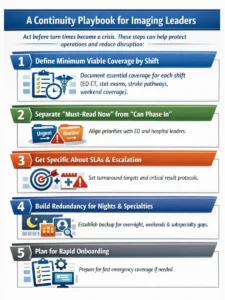
If you suspect your group is approaching a capacity shortfall, the best time to act is before turn times become a crisis. These steps can help protect operations and reduce disruption:
1) Define minimum viable coverage by shift
Document what must be covered on each shift to protect patient flow (e.g., ED CT, inpatient stat, stroke pathways, weekend coverage). This gives you a clear baseline if you need a stopgap plan.
2) Separate “must-read now” from “can phase in”
Not every study needs the same priority level. Align with ED and hospital leadership on what requires immediate final reads vs. what can be scheduled with acceptable delay.
3) Get specific about SLAs and escalation
If turn times are drifting, vague expectations won’t fix it. Define turnaround targets by priority category and document critical-result escalation pathways so the burden doesn’t land on one manager’s phone.
4) Build redundancy for nights, weekends, and subspecialty reads
Capacity collapses often reveal the weakest links first: overnight coverage, weekend staffing, and subspecialty depth. Even if you don’t outsource everything, having a backup partner for the riskiest windows can stabilize operations.
5) Plan for rapid onboarding before you need it
The fastest transitions happen when leadership has already identified what they’d need for an emergency coverage start: modality volumes, hours, PACS/RIS details, dictation preferences, and communication protocols.
How Vesta supports hospitals when coverage is strained or service is disrupted
When a radiology group can’t keep up, hospitals need dependable coverage that restores momentum—not another layer of complexity. Vesta Teleradiology helps facilities stabilize quickly with a continuity-first approach:
- Scalable capacity to absorb surges and protect turn times
- Subspecialty interpretation options aligned to case complexity
- Clear expectations for turnaround and critical results communication
- Rapid onboarding pathways designed for real hospital workflows
Whether you need temporary stabilization, overflow coverage, nights/weekends support, or a longer-term solution, we can tailor coverage so your imaging team isn’t forced into constant triage mode.
Every staffing disruption has context. The point isn’t to assign blame—it’s to protect continuity of care and keep clinical operations stable. If your facility is seeing warning signs of coverage strain, we can help you assess options and timelines without speculation about any third party.