
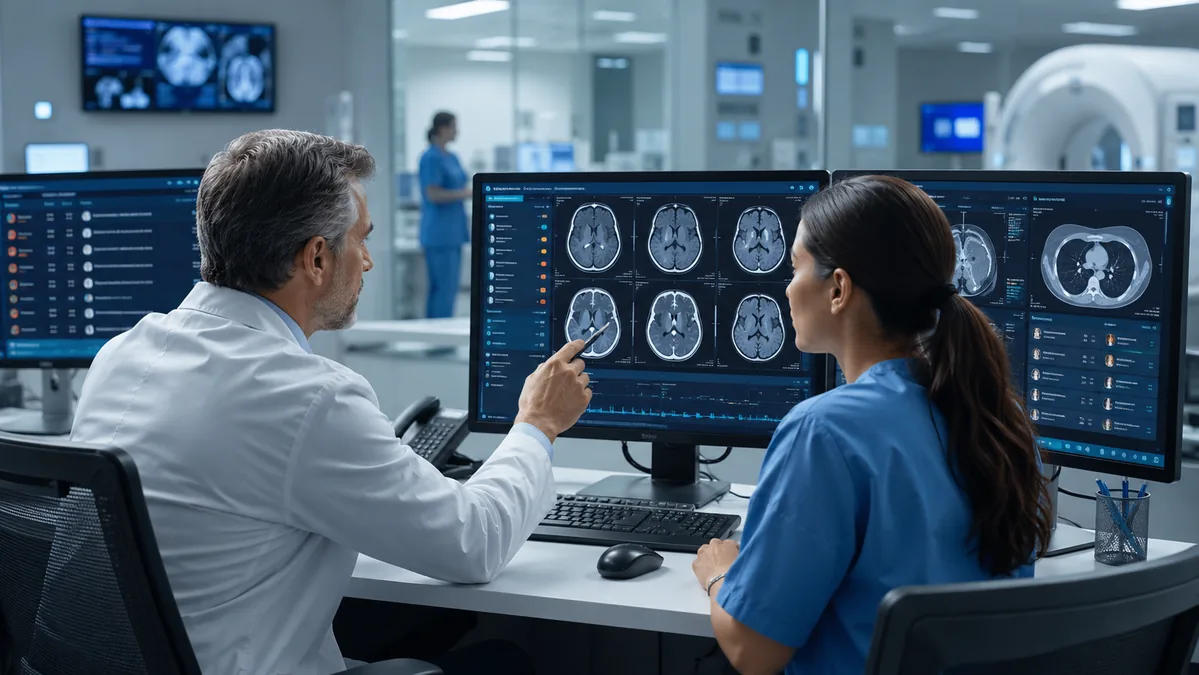
Healthcare organizations are managing increasing imaging demand while facing radiologist shortages, after-hours coverage needs, changing patient volumes, and continued pressure to deliver timely reports.
Artificial intelligence has emerged as one resource that may help radiology teams manage these demands more efficiently.
The greatest value often comes from using AI for focused workflow assistance. Within teleradiology, this can include helping prioritize select studies, surfacing potentially important findings, and supporting consistency during high-volume reading periods.
At Vesta Teleradiology, AI-assisted imaging support operates within a radiologist-led model. Technology provides advisory information, while U.S. board-certified radiologists review the complete study, apply clinical judgment, and finalize every report.
What Is AI-Assisted Teleradiology?
AI-assisted teleradiology combines remote radiology interpretation with software designed to analyze select medical images.
Depending on the type of study and authorized use of the technology, an AI tool may:
- Highlight a region that may require closer review
- Flag a study that could contain a time-sensitive finding
- Help organize or prioritize the reading worklist
- Provide an additional layer of workflow support
- Assist with consistency during periods of high imaging volume
The output serves as advisory information for the radiologist.
The American College of Radiology’s imaging AI practice parameter emphasizes qualified physician involvement, appropriate validation, user training, performance monitoring, and quality assurance when AI is incorporated into clinical imaging.
How AI Can Support Worklist Prioritization
A radiologist’s worklist may contain studies from emergency departments, inpatient units, urgent care facilities, imaging centers, and outpatient practices.
During busy periods, several urgent and routine studies can arrive within a short time. Traditional priority designations remain important, and AI-assisted analysis may offer another signal that helps bring select studies to a radiologist’s attention.
For example, an AI-assisted tool may flag a non-contrast CT brain study containing features associated with a potentially urgent finding. The study can then receive earlier visibility within the workflow.
The radiologist evaluates the complete examination, reviews the patient’s available clinical information, considers other possible findings, and provides the final report.
This structure combines computational assistance with the context, experience, and judgment of a physician.
Current Areas of AI-Assisted Support at Vesta
Vesta has introduced AI-assisted support for select studies in three high-impact areas.
Non-Contrast CT Brain
Within Vesta’s collaboration with Qure.ai, AI-assisted support is used for select non-contrast CT brain workflows, including the identification and prioritization of suspected intracranial hemorrhage.
The technology provides advisory information that may help bring a potentially urgent examination to earlier attention. The Vesta radiologist reviews the complete study, evaluates all relevant and incidental findings, and issues the final report.
Qure.ai’s FDA-cleared head CT technology includes applications involving intracranial bleeding, mass effect, midline shift, and cranial fractures. Vesta’s specific implementation should only describe the capabilities that are currently approved and active within Vesta’s workflow.
Chest X-Ray
Chest X-rays represent a significant portion of imaging volume across hospitals, urgent care centers, physician offices, and outpatient imaging facilities.
AI-assisted analysis can help surface select chest findings for radiologist review and support prioritization within a busy worklist.
Within Vesta’s collaboration with Qure.ai, chest X-ray support includes select findings such as pleural effusion, pneumonia, and other applicable chest abnormalities. These outputs are advisory and are reviewed alongside the complete examination by a Vesta radiologist.
Qure.ai has received FDA clearances for multiple chest X-ray applications designed to identify, highlight, categorize, or prioritize select findings for healthcare professionals. Its cleared applications include support involving pleural effusion and pneumothorax, and Qure.ai announced additional chest X-ray indications in 2026
The radiologist remains responsible for evaluating the complete image, considering available clinical information, and providing the final interpretation.
Musculoskeletal X-Ray Fracture Support
Suspected fractures are common in emergency departments, urgent care clinics, orthopedic practices, and outpatient imaging centers.
AI-assisted fracture support can highlight areas that may deserve additional attention. The radiologist reviews the complete image set and determines the findings included in the final interpretation.
Why Workflow Integration Matters
A capable AI tool can still create operational problems when it sits outside the normal reading process.
Separate viewers, additional passwords, new worklists, and disconnected alerts may increase complexity for radiologists and technical teams. They can also make adoption more difficult across a large or distributed radiology practice.
Vesta’s AI-assisted tools are embedded into the existing reading environment for select studies. This approach is designed to avoid unnecessary changes for client facilities.
Healthcare organizations continue receiving reports through their established delivery process. Vesta radiologists receive the available AI-assisted information within their clinical workflow.
The result is a more practical form of implementation that supports innovation while limiting disruption.
Radiologist-Led Interpretation Remains Essential
Medical images contain complex patterns that must be interpreted within the broader clinical picture.
AI can analyze designated features within an image, while the radiologist evaluates the entire examination. The radiologist also considers patient history, prior imaging, technical image quality, clinical indications, incidental findings, and possible alternative explanations.
This is why Vesta keeps physician oversight at the center of every AI-assisted case.
The Joint Commission and the Coalition for Health AI have also emphasized responsible governance, safety, transparency, monitoring, and accountability when healthcare organizations adopt AI.
A successful AI strategy should reinforce established clinical responsibility.
Questions Facilities Should Ask About Imaging AI
Hospitals and imaging organizations evaluating AI-assisted radiology services should consider several practical questions:
- Does the technology address a meaningful clinical or operational need?
- Has the tool been evaluated for the intended imaging use?
- How does the AI output appear within the radiologist’s workflow?
- Who remains responsible for the final interpretation?
- How is performance monitored after implementation?
- Will the facility need new viewers, logins, or reporting processes?
- How will clinicians and operational leaders provide feedback?
- What quality oversight processes are in place?
These questions help separate meaningful implementation from technology that adds complexity without solving a clear workflow problem.
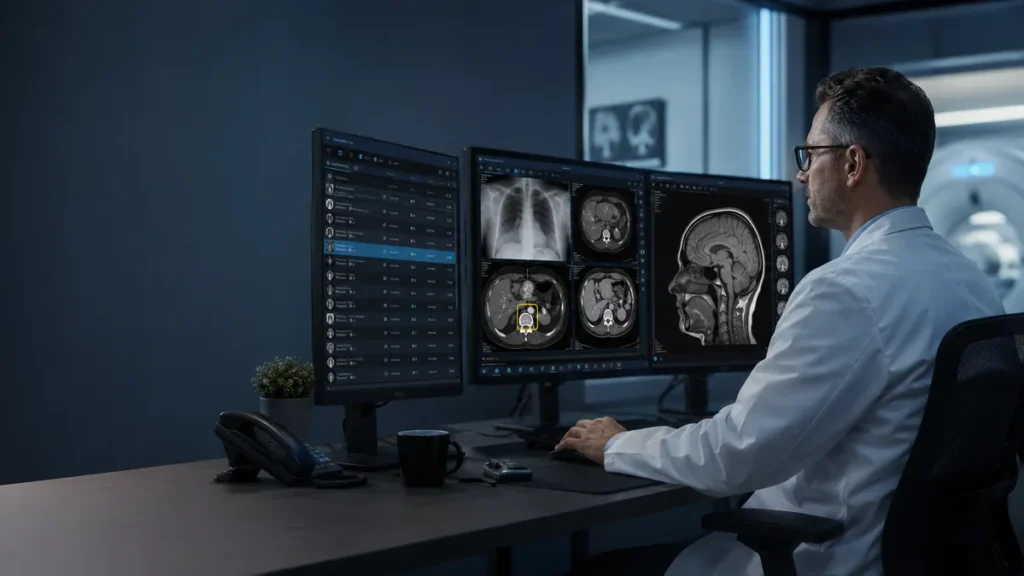 Building AI Around Real Healthcare Needs
Vesta’s AI Innovation Roadmap is centered on practical use cases that can support quality, prioritization, consistency, and workflow efficiency.
The technology works alongside Vesta’s U.S. board-certified radiologists, 24/7 nationwide coverage, Nighthawk services, subspecialty reads, and customized overflow support. Vesta’s Joint Commission accreditation further reflects its commitment to quality-focused processes and dependable service.
As capabilities expand, client feedback will continue to guide Vesta’s priorities.
Facilities are encouraged to share their experiences with report quality, turnaround times, communication, clinical workflow, and other imaging areas where additional AI-assisted support could provide value.
By combining thoughtful technology adoption with experienced radiologists and strong clinical oversight, Vesta is building an AI-assisted teleradiology model designed for the realities of modern imaging operations.
| Explore a practical, radiologist-led approach to AI
Learn how Vesta can support worklist prioritization and workflow efficiency while fitting into your existing imaging processes. Discuss AI-assisted teleradiology with Vesta. |
Sources
- First Practice Parameter for Imaging AI | American College of Radiology
- Artificial Intelligence-Enabled Medical Devices | U.S. Food and Drug Administration