

After-Hours Imaging Backlogs: Faster Reads, Shorter ED Length of Stay

Radiology leaders have learned something uncomfortable: even if you have radiologist coverage, you can still have imaging gridlock. The reason is increasingly upstream—technologist staffing and capacity.

A widely cited ASRT survey highlighted a radiologic technologist vacancy rate of 18.1%, up from 6.2% only three years earlier, with real impact on patient scheduling and inpatient length of stay. Source: RSNA overview.


A separate summary for imaging executives echoed the same 18.1% vacancy figure and trend.

The practical takeaway: “radiology staffing” is no longer just a radiologist conversation. Here’s a leader-focused playbook to reduce delays without lowering standards.

How the tech shortage shows up in real metrics

You’ll usually see it in one (or all) of these:

  • Longer time-to-scan (schedule access deteriorates)
  • Higher no-show / reschedule rates (patients can’t find workable slots)
  • More repeats (fatigue + rushing increases error risk)
  • Backlogs that “mysteriously” worsen after holidays, flu surges, or PTO season

A 6-step action plan to reduce delays fast

1) Separate “demand” from “avoidable demand”

Not all imaging volume is equally necessary.

  • Review repeats, protocol errors, and “wrong exam” orders.
  • Tighten ordering pathways with clinicians (standardize indications and exam selection).

Even a small drop in repeat imaging can return capacity.

2) Standardize protocols to reduce tech time per exam

Protocol sprawl increases cognitive load and exam duration.

  • Build a lean “default” protocol set for top 20 exams.
  • Use tech-friendly checklists for complex exams (MRI safety, contrast workflows).
  • Reduce variations across sites in a system.
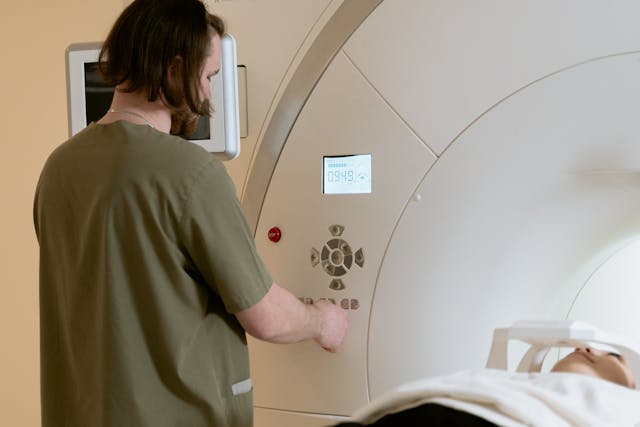
man operating an MRI machine3) Smooth scheduling around your true capacity

Stop scheduling to an ideal world.

  • Build schedules around realistic staffing (including breaks, transport delays, and room turnover).
  • Protect blocks for ED/inpatient add-ons so outpatient doesn’t implode daily.
  • If you have multiple scanners, assign “quick win” exams to specific rooms to reduce reset time.

4) Use role design to protect your scarce talent

If your MRI tech is doing tasks that don’t require MRI training, you lose throughput.

  • Shift non-licensed tasks away from techs where possible (transport coordination, documentation steps, room prep).
  • Cross-train strategically (don’t cross-train everyone on everything—target the biggest bottlenecks).

5) Measure the right bottleneck metrics

Leaders often track report turnaround time but miss the upstream constraint.
Add:

  • order-to-scan time
  • scan-to-dictation start time
  • exams per tech hour
  • repeat rate (by modality and shift)

6) Backstop interpretation capacity so tech gains don’t get wasted

When tech workflows improve, volume rises—and the next bottleneck becomes reading capacity.


This is where flexible interpretation support helps protect throughput:

  • prevent end-of-day reading pileups
  • keep ED reads moving after-hours
  • maintain consistency when staffing fluctuates

7) Make backlog reduction a burnout intervention

Overnight backlog doesn’t only harm metrics—it burns people out. A calmer, more predictable workflow improves clinician experience and decreases error risk.


Where Vesta fits


Vesta Teleradiology supports hospitals and imaging programs that want to keep overnight and weekend imaging moving—with dependable coverage and consistent interpretation quality. The goal is simple: fewer backlogs, steadier turnaround times, and smoother ED throughput.


The Radiologist Shortage in 2026: Coverage Models That Actually Work

By 2026, many imaging leaders have reached the same conclusion: the answer to workforce pressure isn’t simply “hire harder.” Demand remains high, burnout is real, and subspecialty gaps can be difficult (or impossible) to fill quickly.

That’s why the most resilient organizations are redesigning coverage: building models that protect turnaround time, clinical confidence, and staff sustainability.

The shortage isn’t just a feeling—it’s showing up in projections

Recent research and analysis have focused on projecting radiologist supply and imaging demand over the coming decades, highlighting the risk of persistent shortages if current conditions continue. The Neiman Health Policy Institute summarized companion studies published in JACR projecting supply and demand trends through 2055.

The operational translation is simple: if your department plans like staffing will “normalize soon,” you may be planning for a world that doesn’t arrive on schedule.

What breaks first when coverage is thin

When departments run lean, the pain doesn’t spread evenly. It concentrates in predictable places:

  • Nights and weekends (coverage strain + fatigue)
  • ED/inpatient surges (worklist spikes)
  • Subspecialty-demand studies (oncology, neuro, MSK, complex body)
  • Communication friction (more callbacks, more clinician dissatisfaction)

The hospitals that stay stable build models that defend those pressure points first.

Coverage models that work in 2026

Infographic showing four radiology coverage models: core plus overflow, dedicated after-hours, subspecialty on-demand, and hybrid scheduling to reduce burnout and protect turnaround time.

Here are four models that are proving practical in the real world:

1) “Core + overflow” (daytime stability, surge protection)

Your in-house team remains the core, but overflow coverage prevents backlog spirals when volume spikes. This is especially useful during:

  • seasonal peaks
  • staffing gaps (vacations, sick leave)
  • new service line growth

2) Dedicated after-hours coverage (protect your daytime team)

Instead of stretching your day staff into nights, create a defined after-hours plan. The goal is not just coverage—it’s preventing cumulative fatigue that degrades performance over time.

3) Subspecialty on-demand (quality where it matters most)

Rather than trying to hire every subspecialty locally, many hospitals use targeted subspecialty coverage for:

  • oncology staging/follow-up
  • neuro pathways
  • high-impact MSK cases
  • complex body imaging

This reduces risk and increases clinician confidence—without requiring full-time local recruitment for every niche.

4) Hybrid scheduling (reduce burnout and stabilize throughput)

Hybrid models combine:

  • predictable in-house shifts for continuity and relationships
  • external support to protect turnaround time and reduce overtime

These models can also support recruitment—because fewer radiologists want “always-on” schedules in 2026.

How to evaluate whether your model is working

Pick metrics that reflect real operational health:

  • Median and 90th percentile TAT by modality
  • Backlog hours at key times (end of day, weekends)
  • Discrepancy trends / peer review signals
  • Clinician satisfaction or complaint patterns
  • Radiologist overtime hours and call burden

If those metrics are improving, your model is working—even if you still feel “busy.”

Where Vesta fits

Vesta Teleradiology supports hospitals with flexible coverage models—overflow, nights/weekends, and subspecialty interpretation—built to protect turnaround times and clinical confidence without overloading your core team.

If you’re redesigning coverage for 2026, start with your pressure points and build outward. Learn more at https://vestarad.com.