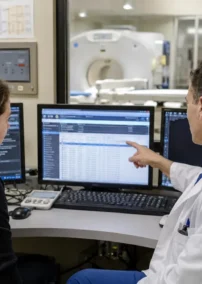
Choosing a teleradiology company is about more than finding coverage for nights, weekends, or overflow volume. Hospitals and imaging providers need a radiology partner they can trust to support quality, communication, and consistency across the imaging workflow. That is why a company’s Joint Commission accreditation matters.
The Joint Commission describes accreditation as an objective evaluation process that helps healthcare organizations measure, assess, and improve performance in order to provide safe, high-quality care (The Joint Commission). When a teleradiology company has earned that accreditation, it signals that the organization has gone through a recognized review process tied to quality and patient safety standards.
Why Accreditation Matters in Teleradiology
Teleradiology plays a critical role in patient care, especially after hours. Remote radiologists may support emergency departments overnight, help hospitals manage weekend volumes, provide overflow assistance, or expand access to subspecialty reads.
The American College of Radiology notes that radiology has long been at the forefront of telemedicine innovation and that teleradiology has seen especially strong reliance in settings such as rural care environments (American College of Radiology).
Because teleradiology affects clinical decision-making, hospitals need more than availability alone. They need confidence that the company supporting their imaging workflow is built around dependable systems, clear communication, and strong quality processes.
A teleradiology provider becomes an extension of the radiology department. That means the standards behind the service matter.
What Joint Commission Accreditation Signals
Joint Commission accreditation does not mean every provider is identical, and it does not replace a full operational review. But it does signal that an organization has been evaluated against recognized standards related to healthcare quality and safety.
A commitment to quality
Accreditation shows that the organization has invested in structured processes and accountability rather than operating on an informal or inconsistent model.
A framework for continuous improvement
Joint Commission standards are designed to help organizations measure and improve performance over time rather than simply meet a one-time benchmark.
Greater confidence for hospitals
When hospitals evaluate an outside radiology partner, accreditation can help support trust. It gives leadership and stakeholders another reason to feel confident that the provider takes patient safety, operational consistency, and service quality seriously.
Why This Matters When Choosing a Teleradiology Company
Teleradiology partnerships affect far more than report turnaround. A provider may be supporting emergency imaging overnight, helping hospitals maintain weekend coverage, or stepping in during high-volume periods when internal teams are stretched. In all of those situations, hospitals need reliability. They need clear communication pathways, stable operations, and a company that understands the expectations of healthcare delivery.
That is why accreditation matters in a practical sense. It helps indicate that the teleradiology company is not simply offering reads from a distance. It is operating within a framework designed to support quality care.
A hospital may never want to rely on accreditation alone as its only decision factor, but it can be a meaningful signal when comparing options.
Key service areas hospitals often evaluate
- After-hours Nighthawk coverage
- Subspecialty radiology support
- Overflow and backlog relief
- Ongoing radiology partnership models
- Support for quality-sensitive hospital environments

What Hospitals Should Look for Beyond Accreditation
U.S. board-certified radiologists
Hospitals should understand who is interpreting studies and whether the provider’s radiologists are properly credentialed and qualified for the work being performed.
Reliable turnaround times
Fast and consistent turnaround remains essential, especially for emergency and after-hours imaging.
Strong communication processes
Urgent findings need to be communicated effectively. A quality radiology partner should have dependable protocols for critical results communication.
Subspecialty availability
Some facilities need more than general coverage. Access to subspecialty radiologists can be important for more complex studies and service lines.
Workflow compatibility
Technology and implementation matter. Hospitals generally benefit most from a provider that fits into existing systems and workflows without unnecessary friction.
Why Hospitals Choose Vesta
For hospitals and imaging providers looking for a dependable radiology partner, Vesta combines the credibility of Joint Commission accreditation with practical support built for real clinical environments.
Vesta provides 24/7 nationwide teleradiology services for hospitals, imaging centers, urgent care facilities, and physician groups. That includes Nighthawk coverage, subspecialty radiology reads, and dependable support during nights, weekends, holidays, and peak volume periods.
Vesta’s model is designed around the realities hospitals face every day: maintaining turnaround times, reducing strain on internal teams, supporting after-hours continuity, and improving workflow efficiency without adding unnecessary disruption.
Vesta also offers AI-assisted imaging support for select studies, designed to improve prioritization and workflow efficiency while keeping interpretation radiologist-led. AI outputs are advisory only, embedded directly into the existing reading workflow, with no separate viewer, no additional logins, and no change to report delivery.
Frequently Asked Questions
What does Joint Commission accreditation mean for a teleradiology company?
It means the organization has gone through a recognized evaluation process focused on healthcare quality, safety, and performance standards.
Why should hospitals care if a teleradiology company is Joint Commission accredited?
Accreditation can help hospitals feel more confident that the provider follows structured quality processes and takes patient safety and operational consistency seriously.
Is accreditation the only thing hospitals should look for in a teleradiology provider?
No. Hospitals should also review radiologist qualifications, turnaround times, subspecialty coverage, communication processes, and workflow compatibility.
Does Joint Commission accreditation guarantee better radiology reads?
Accreditation does not guarantee every outcome, but it is a strong signal that the organization has invested in recognized standards and continuous quality improvement.
Why does accreditation matter for after-hours radiology coverage?
After-hours imaging still requires dependable quality, communication, and workflow support. Accreditation helps reinforce confidence in the provider behind that service.
Why do hospitals choose Vesta as a teleradiology partner?
Hospitals choose Vesta for Joint Commission accredited service, 24/7 nationwide coverage, U.S. board-certified radiologists, subspecialty support, and workflow-friendly AI-assisted imaging support.
Choose a Teleradiology Partner Built for Quality
Hospitals need a teleradiology partner with trusted standards, dependable service, and a workflow that supports real clinical demands. Vesta combines Joint Commission accredited service with 24/7 nationwide coverage, U.S. board-certified radiologists, subspecialty reads, and AI-assisted workflow support built into the existing reading environment. Contact Vesta to learn how we can support your team with quality-focused teleradiology coverage.