Artificial intelligence is moving rapidly across healthcare, but successful adoption in radiology requires more than adding another technology platform. It requires careful clinical evaluation, thoughtful workflow integration, ongoing quality oversight, and a clear understanding of how the technology supports radiologists.
During the second quarter of 2026, Vesta Teleradiology continued making meaningful progress on the first phase of its AI Innovation Roadmap.
This phase focuses on introducing a limited number of clinically validated AI tools in high-impact areas of radiology. The emphasis remains on quality, patient safety, workflow efficiency, and the physician-led oversight healthcare organizations expect from Vesta.
A Focused Approach to AI-Assisted Teleradiology
Vesta’s approach begins with a practical question: Where can AI provide meaningful assistance within the existing radiology workflow?
Vesta began with select imaging studies where AI-assisted support may help surface time-sensitive findings and improve worklist prioritization. Current areas of support include:
- Non-contrast CT brain studies
- Chest X-rays
- Musculoskeletal X-rays with fracture support
These tools provide advisory information within the reading environment. Each study continues to be reviewed, interpreted, and finalized by a U.S. board-certified Vesta radiologist.
| Radiologist-led by design
The radiologist remains responsible for every interpretation and final report. |
Supporting Earlier Prioritization of Urgent Studies
One of the most practical applications of imaging AI involves prioritization.
Radiology departments may receive many studies simultaneously, particularly during high-volume periods, overnight shifts, weekends, and unexpected volume surges. AI-assisted tools can help identify select studies that may contain urgent findings and bring them to the radiologist’s attention sooner.
The technology provides another source of information that can help radiologists organize worklists and focus attention where it may be needed first. The radiologist continues to determine the diagnosis and apply clinical judgment.
During Q2, Vesta concentrated on several operational priorities:
- Earlier visibility into potentially critical findings
- Greater consistency during high-volume reading periods
- Faster prioritization of select urgent studies
- Improved radiologist workflow efficiency
- Continued physician-led quality oversight
- Maintaining diagnostic excellence while reducing avoidable delays
These areas reflect how Vesta evaluates innovation. The value of a tool depends on how effectively it supports the people using it and the healthcare organizations relying on the service.
AI That Fits the Existing Workflow
Technology adoption can become difficult when it introduces additional viewers, separate logins, disconnected worklists, or changes to report delivery.
Vesta’s AI-assisted imaging support is designed to operate within the existing clinical reading environment. Select AI outputs are presented directly within the workflow used by Vesta radiologists.
For client facilities, there is no separate AI viewer to manage, no additional account to maintain, and no fundamental change to how reports are delivered.
This integrated approach helps Vesta introduce new capabilities while preserving the familiar processes healthcare teams already use.
Collaborating With Qure.ai
As one component of its broader AI Innovation Roadmap, Vesta is collaborating with Qure.ai, a healthcare AI company that develops medical imaging technologies.
Within Vesta’s current collaboration, Qure.ai supports select AI-assisted workflows involving non-contrast CT brain examinations and chest X-rays. These applications are designed to help identify and prioritize select imaging findings for radiologist review.
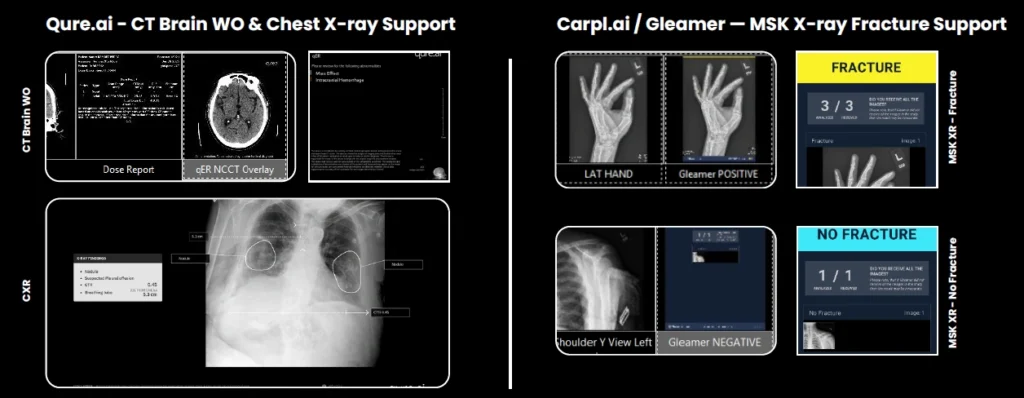 The collaboration supports Vesta’s broader effort to evaluate and implement clinically appropriate AI capabilities within a radiologist-led teleradiology environment. Qure.ai is one of multiple technology partners contributing to Vesta’s wider strategy for improving automation, workflow efficiency, prioritization, and quality.
AI outputs remain advisory. Vesta’s U.S. board-certified radiologists review the complete examination, apply clinical judgment, and remain responsible for every final interpretation and report.
The FDA maintains a public list of AI-enabled medical devices authorized for marketing in the United States, providing healthcare organizations with greater visibility into the evolving medical AI landscape.
Responsible Implementation Matters
Healthcare organizations are increasingly looking beyond whether an AI tool can perform a task. They also want to know how it will be introduced, monitored, governed, and incorporated into clinical decision-making.
In May 2026, the American College of Radiology approved its first practice parameter for imaging AI. The parameter addresses areas such as validation, training, monitoring, workflow integration, and ongoing quality assurance.
These principles align with Vesta’s measured approach.
Technology should support clinical judgment, strengthen workflow consistency, and help healthcare teams deliver dependable imaging services. Every implementation should also include appropriate oversight and continued evaluation.
Client Feedback Will Help Shape the Next Phase
As Vesta expands its AI-assisted imaging capabilities, feedback from hospitals, urgent care facilities, imaging centers, and other healthcare partners will help guide future priorities.
Vesta is especially interested in hearing about:
- Report quality
- Turnaround times
- Clinical workflow
- Communication
- Additional AI-assisted capabilities that facilities would find valuable
This feedback helps Vesta focus its innovation roadmap on solutions that address real operational and clinical needs.
Moving Forward With Purpose
Vesta’s Q2 progress represents another step toward integrating AI responsibly into nationwide teleradiology services.
The combination of U.S. board-certified radiologists, advanced technology, dependable clinical processes, and client collaboration can support a stronger imaging workflow. Vesta will continue evaluating opportunities that improve prioritization, quality, efficiency, and access while preserving radiologist-led interpretation.
| Your feedback matters
Share your experience with report quality, turnaround times, clinical workflow, communication, and the additional AI capabilities that could create value for your organization and patients. Contact your Vesta Account Manager or connect with the Vesta team. |
Sources
- First Practice Parameter for Imaging AI | American College of Radiology
- Artificial Intelligence-Enabled Medical Devices | U.S. Food and Drug Administration
- Qure.ai U.S. News and Press Coverage | Qure.ai