
November 29 – December 3, 2026 | McCormick Place, Chicago
Radiology departments are being asked to do more every day. Imaging volumes continue to grow, staffing remains a challenge, and clinical teams depend on timely reports and clear communication to keep patient care moving.
According to research published in the Journal of the American College of Radiology, U.S. imaging utilization is projected to increase approximately 17% to 27% by 2055 compared with 2023, assuming current per-person utilization remains stable.
For hospitals and imaging centers already balancing busy schedules, overnight coverage, and rising expectations, finding more efficient ways to work is increasingly important.
These challenges are helping shape the next chapter of innovation at Vesta Teleradiology.
We’re looking forward to attending RSNA 2026 in Chicago, where we’ll connect with hospital leaders, radiologists, and imaging professionals to discuss how AI-assisted technologies and intelligent automation can support more connected radiology workflows.
Bringing AI Into Everyday Radiology
Artificial intelligence is opening new possibilities throughout radiology, extending from imaging analysis to reporting, communication, and operational support.
At Vesta, we’re exploring how these technologies can help radiologists spend less time on repetitive tasks while improving the flow of information between reading teams and hospital partners.
Keeping clinical expertise at the center of these advancements remains essential.
In fact, an RSNA-published report on a survey of 518 mammography patients found that 71% preferred AI as a second reader alongside a radiologist, while fewer than 5% were comfortable with AI interpreting their mammograms independently.
Although this research focused specifically on breast imaging, it offers an interesting perspective on the importance patients place on physician involvement as AI becomes more common in medical imaging.
Vesta’s approach builds on this principle, integrating AI-assisted capabilities into existing workflows while keeping interpretation and final reporting in the hands of U.S. board-certified radiologists.
A Look at What’s New and What’s Ahead at Vesta
As part of our broader technology initiatives, we’re advancing several areas designed to improve efficiency, communication, and the overall teleradiology experience.
Smarter Case Assignment and Workflow Management
Getting the right study to the right radiologist is an important part of maintaining efficient turnaround times.
Vesta is developing intelligent case-assignment capabilities that consider radiologist credentials, availability, workload, and study urgency. These enhancements are designed to support more efficient study distribution, particularly when imaging volumes fluctuate or after-hours demands increase.
AI-Assisted Imaging and Reporting
Vesta continues to explore new applications for AI throughout the interpretation and reporting process.
Our current AI-assisted imaging support includes select CT Brain, Chest X-ray, and musculoskeletal X-ray studies, with additional reporting technologies under evaluation.
We’re also exploring intelligent dictation, structured reporting, automated consistency checks, and clinical reference tools that could help radiologists work more efficiently while maintaining reporting quality.
More Proactive Hospital Communication
Anyone working in a busy radiology department understands how important timely communication can be, especially when a critical result, missing information, or delayed report requires immediate attention.
Vesta is advancing communication workflows that help coordinate critical findings notifications, turnaround time updates, report addenda, and other important follow-ups.
These initiatives are intended to improve communication between Vesta’s teams and the hospital professionals who rely on our services.
Better Connectivity and Operational Visibility
Behind every radiology report is a network of systems, people, and processes that need to work together.
We’re investing in interoperability, infrastructure modernization, and operational analytics to support more reliable hospital connectivity and greater visibility into radiology performance.
This includes continued work involving EHR integrations, HL7/FHIR interfaces, DICOM connectivity, quality assurance, and turnaround time monitoring.
Supporting the People Behind Every Read
As imaging demands grow, finding ways to reduce unnecessary steps in the radiology workflow becomes increasingly valuable.
An intelligently routed study, a more streamlined report, or a timely communication update can help clinical teams stay focused on patient care.
These developments build on Vesta’s established 24/7 nationwide teleradiology services, including Nighthawk coverage, overflow support, and subspecialty interpretation by U.S. board-certified radiologists.
As a Joint Commission-accredited teleradiology provider, Vesta continues to invest in technology and services that support dependable coverage and strong hospital partnerships.
Let’s Connect at RSNA 2026
This year’s RSNA theme, “At the Center of Care,” highlights the important role radiologists play in connecting technology, clinical expertise, and patient care.
It’s a fitting opportunity for Vesta to share where we’re headed and hear directly from the hospital and imaging professionals we serve.
What would make your radiology workflows more efficient? Where could better communication help your clinical teams? Are there reporting challenges or new technologies you’d like to explore?
We’d welcome the opportunity to discuss these questions, share our latest initiatives, and learn more about your organization’s needs.
If you’re attending RSNA 2026, let’s connect in Chicago!
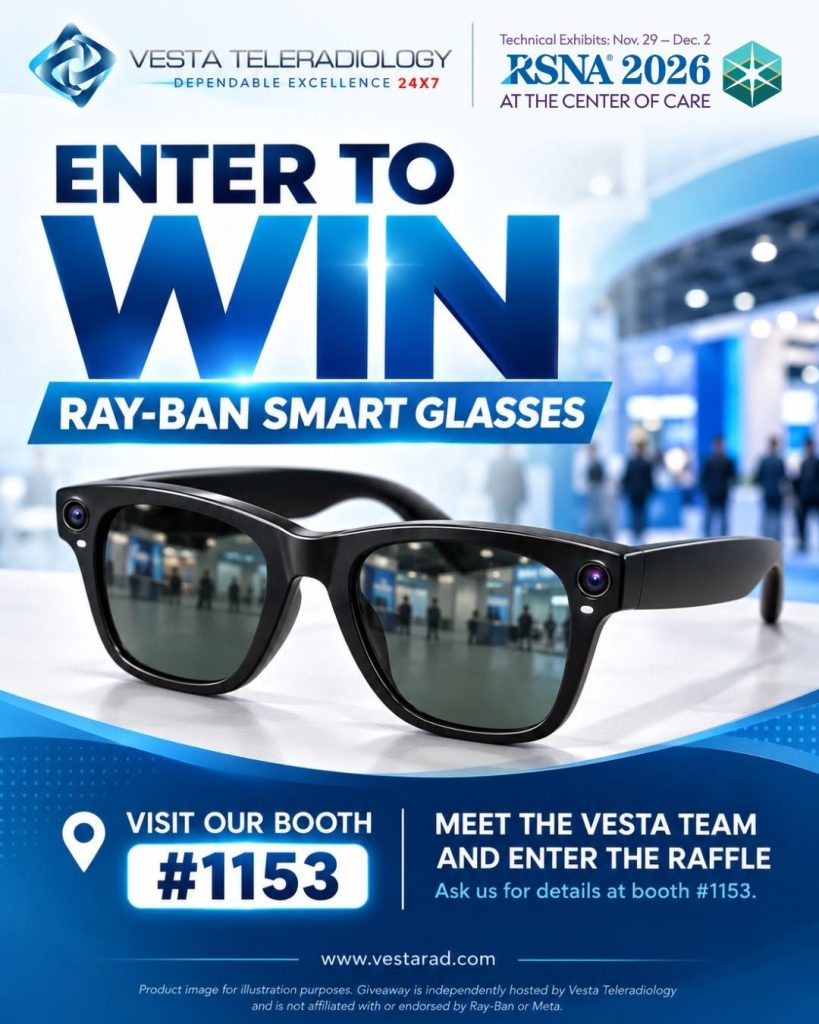
Visit Vesta at RSNA 2026 for a Chance to Win Ray-Ban Meta Smart Glasses! 🕶️
We’re adding a little extra excitement to RSNA 2026! Stop by Vesta Teleradiology at Booth #1153 for a chance to win a pair of Ray-Ban Meta smart glasses. To enter, simply visit our booth and have your attendee badge scanned by a member of our team. We’ll select one lucky winner during a drawing on December 3, the final day of the conference, and announce the winner afterward. While you’re there, meet our team, explore Vesta’s latest AI-assisted radiology innovations, and discover what’s ahead for our connected radiology services. We look forward to seeing you in Chicago!
 Sources
- Journal of the American College of Radiology: Projected US Imaging Utilization, 2025 to 2055
- RSNA: Patients Support AI as Backup in Mammography Screening
- American College of Radiology: The Radiologist Shortage, A Workforce Update
- RSNA 2026 Annual Meeting
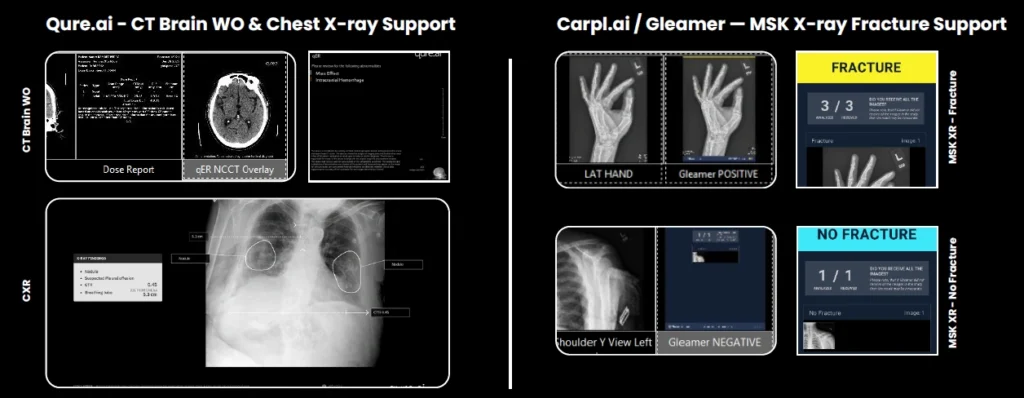 The collaboration supports Vesta’s broader effort to evaluate and implement clinically appropriate AI capabilities within a radiologist-led teleradiology environment. Qure.ai is one of multiple technology partners contributing to Vesta’s wider strategy for improving automation, workflow efficiency, prioritization, and quality.