Outpatient MRI Interpretation Services: Managing Late-Day and Weekend Reporting


Outpatient imaging centers have become an important part of diagnostic healthcare, providing patients with convenient access to MRI examinations for neurological, musculoskeletal, abdominal, and other medical conditions. As facilities expand appointment availability to accommodate patient demand, radiology reading schedules may need to accommodate a growing number of late-day and weekend studies.

For imaging center administrators, maintaining reliable interpretation services involves coordinating scanner availability, radiologist schedules, reporting expectations, and communication with referring physicians. A facility may have the technical capacity to complete additional examinations, but the reporting workflow also needs sufficient radiologist coverage to support those appointments.

Outpatient MRI interpretation services can help imaging centers manage these scheduling challenges while maintaining access to qualified radiologists and established reporting procedures.

MRI Demand and the Changing Outpatient Imaging Environment

MRI continues to play a significant role in diagnostic imaging because of its ability to provide detailed views of soft tissue, joints, the brain, spine, and internal organs without using ionizing radiation.

A 2024 analysis published in Health Affairs Scholar examined medical imaging utilization among commercially insured Americans between 2010 and 2021. Researchers found that MRI’s share of imaging examinations increased from 6.92% to 7.38% during that period. CT and ultrasound also accounted for larger shares of imaging utilization.

Although the findings describe historical changes within an employer-insured population rather than current national MRI volumes, they illustrate MRI’s growing proportion of diagnostic imaging services over the study period.


For outpatient centers, changes in demand can influence appointment scheduling, staffing, equipment utilization, and reporting arrangements. Some facilities offer evening or weekend appointments to provide greater flexibility for patients, particularly those balancing work schedules, caregiving responsibilities, or travel requirements.

Extending scanning hours, however, also requires administrators to consider how those studies will be interpreted and when reports will be available to referring providers.

Why Late-Day MRI Reporting Can Become Complicated

MRI examinations are not necessarily completed at the same pace throughout the day. A complex study may require additional sequences, certain patients need more time in the scanner, and unexpected scheduling changes can affect the number of examinations completed before closing.

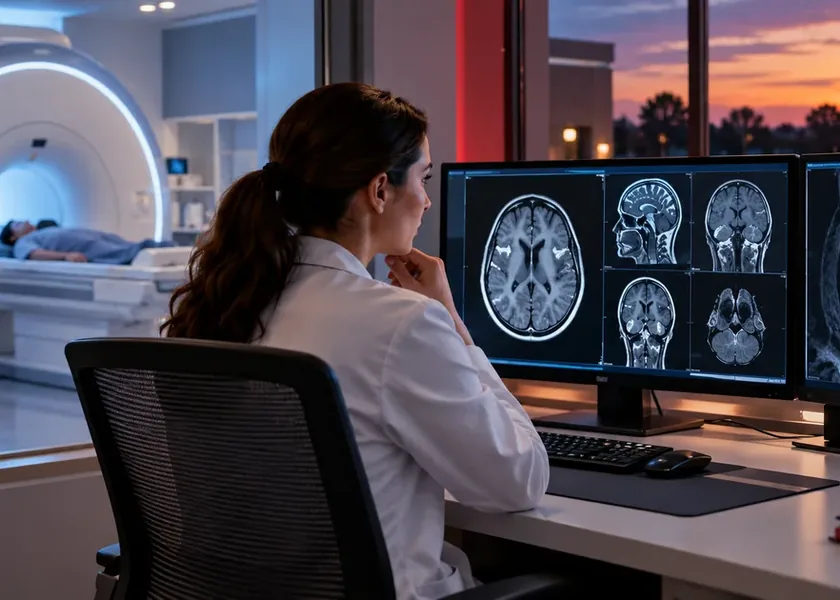
When the final patients of the day finish their examinations, the interpreting radiologist may already be approaching the end of a scheduled shift. If the imaging center depends on a limited number of radiologists, reporting workloads can carry into the following business day.

Over time, these interruptions may complicate reporting schedules, particularly during vacations, staffing changes, or periods of increased examination volume.

An outpatient MRI interpretation arrangement can provide additional reading capacity during designated hours or when a facility experiences an unexpected increase in studies.

The most appropriate coverage model depends on the center’s examination volume, report delivery requirements, available radiologists, and the types of MRI studies performed.

The Importance of Timely MRI Interpretation

Completing an MRI examination is one stage of the diagnostic process. The interpreting radiologist must review the images, consider relevant clinical information, and prepare a report that can be communicated to the referring provider.

Research has highlighted the importance of timely outpatient MRI access. A 2024 study in the Journal of the American College of Radiology, titled Factors Associated With Timeliness and Equity of Access to Outpatient MRI Examinations, examined factors associated with delays between MRI orders and completed examinations at a large healthcare system.

The researchers specifically evaluated prolonged scheduling intervals, including examinations completed more than 10 days beyond their expected timing criteria.

While that research focused on obtaining examinations rather than reporting turnaround times, it reinforces the importance of evaluating the complete imaging process. Facilities seeking to improve access should consider whether interpretation and reporting capacity can accommodate additional examinations.

For example, an imaging center that expands Saturday appointments may benefit from arranging corresponding weekend reading services rather than allowing the entire reporting workload to accumulate for Monday.

Access to Subspecialty MRI Interpretation

MRI studies cover a wide range of clinical applications, and different examinations may benefit from radiologists with additional expertise in particular areas.

A center performing high volumes of orthopedic examinations may require musculoskeletal radiology support, while facilities providing brain and spine MRI examinations may benefit from access to neuroradiology expertise.

Other centers may need body imaging specialists for abdominal and pelvic examinations or broader general diagnostic interpretation services for a varied patient population.

Teleradiology allows imaging facilities to access a network of U.S. board-certified radiologists without requiring every interpreting physician to be physically present at the center.

This can be particularly useful for smaller facilities that perform several MRI examination types but do not have enough volume in each category to support dedicated onsite subspecialists.

The American College of Radiology maintains practice parameters covering MRI interpretation and specific examinations, including imaging of the brain, spine, abdomen, and musculoskeletal system. These resources provide professional guidance concerning a

ppropriate performance and interpretation practices.
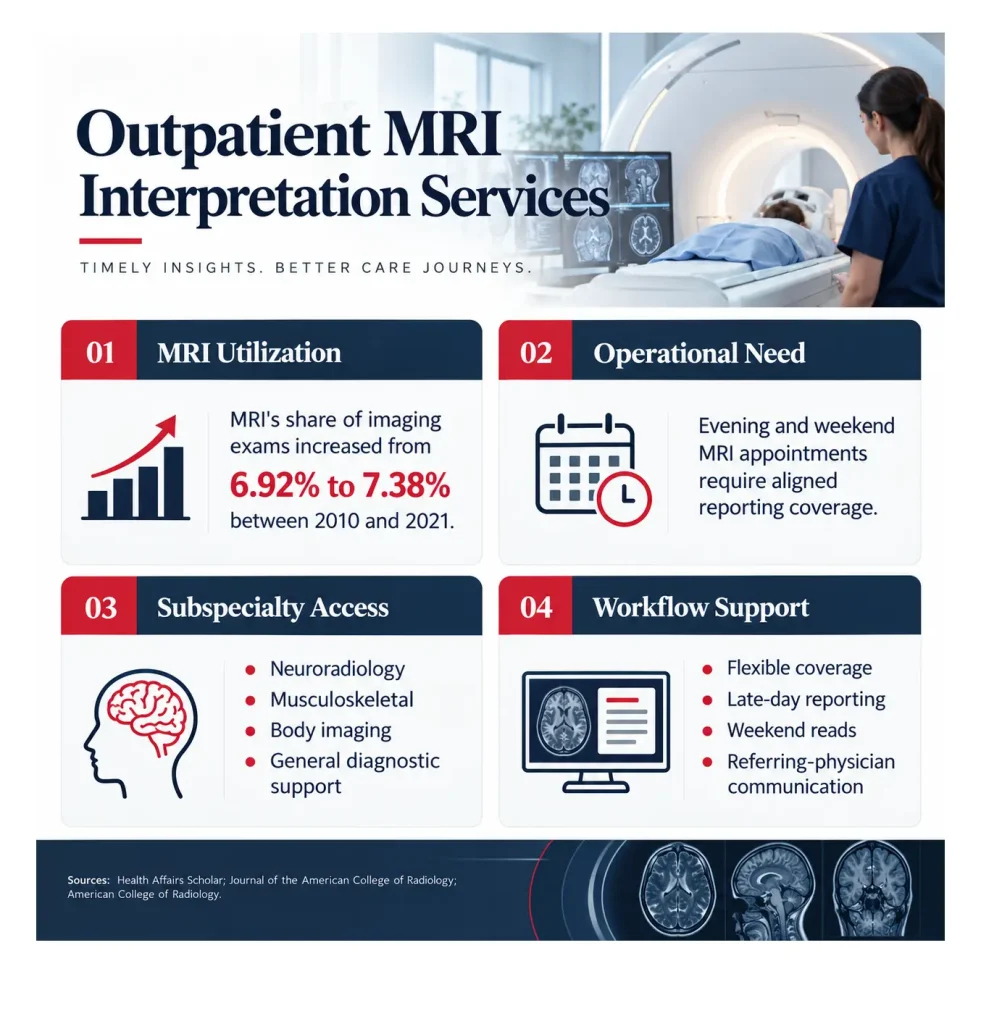
Infographic highlighting MRI utilization trends, evening and weekend interpretation needs, subspecialty radiology access, and flexible outpatient MRI reporting workflows.

Building a Reporting Workflow Around the Imaging Center

Outpatient MRI interpretation works best when the reading arrangement aligns with the facility’s existing systems and operational requirements.

Before establishing outside reading services, administrators should evaluate how studies will be transmitted, how reports will return to the facility, and what clinical information will be available to interpreting radiologists.

Compatibility with picture archiving and communication systems (PACS), radiology information systems (RIS), and other reporting infrastructure can help avoid unnecessary manual steps.

Facilities should also establish expectations for report turnaround times, coverage schedules, and procedures for communicating findings that require additional attention.

The ACR’s practice parameter for communicating diagnostic imaging findings addresses both routine reporting and situations requiring additional communication. These recommendations are relevant to outpatient providers because certain findings may need prompt attention even when the original examination was scheduled as routine.

A well-planned reporting arrangement should account for the referring physician’s needs while minimizing unnecessary changes to how the imaging center operates.

Flexible Coverage for Changing MRI Volumes

Not every imaging center requires the same level of outside radiology support.

Some facilities need consistent interpretation services throughout the week, while others may require additional reading capacity only during evenings, weekends, or seasonal fluctuations. Centers may also use teleradiology to supplement existing radiologists during vacations or periods of unusually high examination volume.

Vesta Teleradiology provides nationwide radiology services through U.S. board-certified radiologists, including general diagnostic and subspecialty interpretation.

With 24/7 coverage capabilities and flexible service arrangements, Vesta can work with imaging centers to develop interpretation support around their scheduling, modality, and reporting needs.

For outpatient imaging facilities considering expanded appointment hours or additional reading resources, coordinating radiologist availability with scanner schedules can help create a more manageable and consistent reporting workflow.

Explore Vesta Teleradiology’s outpatient imaging services to discuss MRI interpretation, subspecialty support, and flexible radiology coverage for your facility.

References

  1. Decomposition of Medical Imaging Spending Growth Between 2010 and 2021 in the US Employer-Insured Population. Health Affairs Scholar, 2024. https://academic.oup.com/healthaffairsscholar/article/2/3/qxae030/7636360
  2. Factors Associated With Timeliness and Equity of Access to Outpatient MRI Examinations. Journal of the American College of Radiology, 2024. https://doi.org/10.1016/j.jacr.2023.12.028
  3. American College of Radiology. Practice Parameters and Technical Standards. https://gravitas.acr.org/ppts
  4. American College of Radiology. Practice Parameter for Communication of Diagnostic Imaging Findings. https://gravitas.acr.org/PPTS/GetDocumentView?docId=74

 

Vesta Teleradiology Heads to RSNA 2026: Advancing AI and Radiology Workflows

November 29 – December 3, 2026 | McCormick Place, Chicago

Radiology departments are being asked to do more every day. Imaging volumes continue to grow, staffing remains a challenge, and clinical teams depend on timely reports and clear communication to keep patient care moving.

According to research published in the Journal of the American College of Radiology, U.S. imaging utilization is projected to increase approximately 17% to 27% by 2055 compared with 2023, assuming current per-person utilization remains stable.

For hospitals and imaging centers already balancing busy schedules, overnight coverage, and rising expectations, finding more efficient ways to work is increasingly important.

These challenges are helping shape the next chapter of innovation at Vesta Teleradiology.

We’re looking forward to attending RSNA 2026 in Chicago, where we’ll connect with hospital leaders, radiologists, and imaging professionals to discuss how AI-assisted technologies and intelligent automation can support more connected radiology workflows.

Bringing AI Into Everyday Radiology

Artificial intelligence is opening new possibilities throughout radiology, extending from imaging analysis to reporting, communication, and operational support.

At Vesta, we’re exploring how these technologies can help radiologists spend less time on repetitive tasks while improving the flow of information between reading teams and hospital partners.

Keeping clinical expertise at the center of these advancements remains essential.

In fact, an RSNA-published report on a survey of 518 mammography patients found that 71% preferred AI as a second reader alongside a radiologist, while fewer than 5% were comfortable with AI interpreting their mammograms independently.

Although this research focused specifically on breast imaging, it offers an interesting perspective on the importance patients place on physician involvement as AI becomes more common in medical imaging.

Vesta’s approach builds on this principle, integrating AI-assisted capabilities into existing workflows while keeping interpretation and final reporting in the hands of U.S. board-certified radiologists.

A Look at What’s New and What’s Ahead at Vesta

As part of our broader technology initiatives, we’re advancing several areas designed to improve efficiency, communication, and the overall teleradiology experience.

Smarter Case Assignment and Workflow Management

Getting the right study to the right radiologist is an important part of maintaining efficient turnaround times.

Vesta is developing intelligent case-assignment capabilities that consider radiologist credentials, availability, workload, and study urgency. These enhancements are designed to support more efficient study distribution, particularly when imaging volumes fluctuate or after-hours demands increase.

AI-Assisted Imaging and Reporting

Vesta continues to explore new applications for AI throughout the interpretation and reporting process.

Our current AI-assisted imaging support includes select CT Brain, Chest X-ray, and musculoskeletal X-ray studies, with additional reporting technologies under evaluation.

We’re also exploring intelligent dictation, structured reporting, automated consistency checks, and clinical reference tools that could help radiologists work more efficiently while maintaining reporting quality.

More Proactive Hospital Communication

Anyone working in a busy radiology department understands how important timely communication can be, especially when a critical result, missing information, or delayed report requires immediate attention.

Vesta is advancing communication workflows that help coordinate critical findings notifications, turnaround time updates, report addenda, and other important follow-ups.

These initiatives are intended to improve communication between Vesta’s teams and the hospital professionals who rely on our services.

Better Connectivity and Operational Visibility

Behind every radiology report is a network of systems, people, and processes that need to work together.

We’re investing in interoperability, infrastructure modernization, and operational analytics to support more reliable hospital connectivity and greater visibility into radiology performance.

This includes continued work involving EHR integrations, HL7/FHIR interfaces, DICOM connectivity, quality assurance, and turnaround time monitoring.

Supporting the People Behind Every Read

As imaging demands grow, finding ways to reduce unnecessary steps in the radiology workflow becomes increasingly valuable.

An intelligently routed study, a more streamlined report, or a timely communication update can help clinical teams stay focused on patient care.

These developments build on Vesta’s established 24/7 nationwide teleradiology services, including Nighthawk coverage, overflow support, and subspecialty interpretation by U.S. board-certified radiologists.

As a Joint Commission-accredited teleradiology provider, Vesta continues to invest in technology and services that support dependable coverage and strong hospital partnerships.

Let’s Connect at RSNA 2026

This year’s RSNA theme, “At the Center of Care,” highlights the important role radiologists play in connecting technology, clinical expertise, and patient care.

It’s a fitting opportunity for Vesta to share where we’re headed and hear directly from the hospital and imaging professionals we serve.

What would make your radiology workflows more efficient? Where could better communication help your clinical teams? Are there reporting challenges or new technologies you’d like to explore?

We’d welcome the opportunity to discuss these questions, share our latest initiatives, and learn more about your organization’s needs.

If you’re attending RSNA 2026, let’s connect in Chicago!

Visit Vesta at RSNA 2026 for a Chance to Win Ray-Ban Meta Smart Glasses! 🕶️

We’re adding a little extra excitement to RSNA 2026! Stop by Vesta Teleradiology at Booth #1153 for a chance to win a pair of Ray-Ban Meta smart glasses. To enter, simply visit our booth and have your attendee badge scanned by a member of our team. We’ll select one lucky winner during a drawing on December 3, the final day of the conference, and announce the winner afterward. While you’re there, meet our team, explore Vesta’s latest AI-assisted radiology innovations, and discover what’s ahead for our connected radiology services. We look forward to seeing you in Chicago!

Sources

  1. Journal of the American College of Radiology: Projected US Imaging Utilization, 2025 to 2055
  2. RSNA: Patients Support AI as Backup in Mammography Screening
  3. American College of Radiology: The Radiologist Shortage, A Workforce Update
  4. RSNA 2026 Annual Meeting


What Is Medality—and Why a One-Year Membership Is a Big Win for Radiologists

If you’ve heard colleagues mention “MRI Online,” you’ve already met Medality—the platform’s new name and broader vision for case-based radiology education and CME. Medality

Medality offers a large, searchable library of subspecialty courses and real cases designed for busy readers. The program is ACCME-accredited to provide AMA PRA Category 1 Credits™, with 700+ hours available to claim—so credits count toward common licensure, MOC, and credentialing needs. (For context on AMA PRA Category 1 Credit™ and ACCME alignment, see AMA/ACCME guidance.) American Medical Association


What makes Medality valuable in day-to-day practice

Case-based, time-efficient learning. The library is built around short, expert-led “microlearning” lessons you can fit between cases—so you steadily upskill without disrupting coverage.

Hands-on practice with scrollable DICOMs. Medality’s case archive includes fully scrollable CT/MR studies plus brief video explanations and quizzes, helping sharpen detection speed and reporting confidence on high-yield findings.

Depth across subspecialties. From neuro and MSK to breast, cardiac, ED and beyond, courses and case sets let you target the areas your case mix demands most.

Accredited CME you’ll actually use. With 700+ AMA PRA Category 1 Credits™ available (and more added regularly), radiologists can chip away at requirements continuously rather than scrambling at renewal time.

MEDALITY CMEWhy this RSNA prize matters for teams—not just individuals

Training without lost coverage. Because lessons are on-demand and bite-sized, radiologists can learn after hours or between reads, preserving TAT while still building subspecialty confidence.

Goal-aligned upskilling. If your facility is seeing more chest pain workups, stroke alerts, or MSK injuries, you can steer readers to focused tracks and track progress via CME claims over the year.

Credentialing peace of mind. AMA PRA Category 1 Credit™ is widely accepted across hospitals and state boards, making a one-year membership a practical asset for QA plans and reappointments. (See the AMA/ACCME alignment noted above.) American Medical Association

“Is it really a $1,500 value?”

Medality’s public promos frequently reference savings or membership values up to $1,500 on premium or multi-year packages—useful as a benchmark for how substantial a full-year membership is compared with typical online CME.

Where Medality complements Vesta’s AI-enabled reading

Vesta blends subspecialty expertise with a pragmatic partner-plus-platform AI approach—dictation, PACS/VNA, and algorithm marketplaces—to deliver predictable quality and TAT. Continuous learning via Medality strengthens the skills behind that workflow, while Vesta’s operations and AI strengthen the throughput—a combined, durable path to better patient care.

How to enter the giveaway
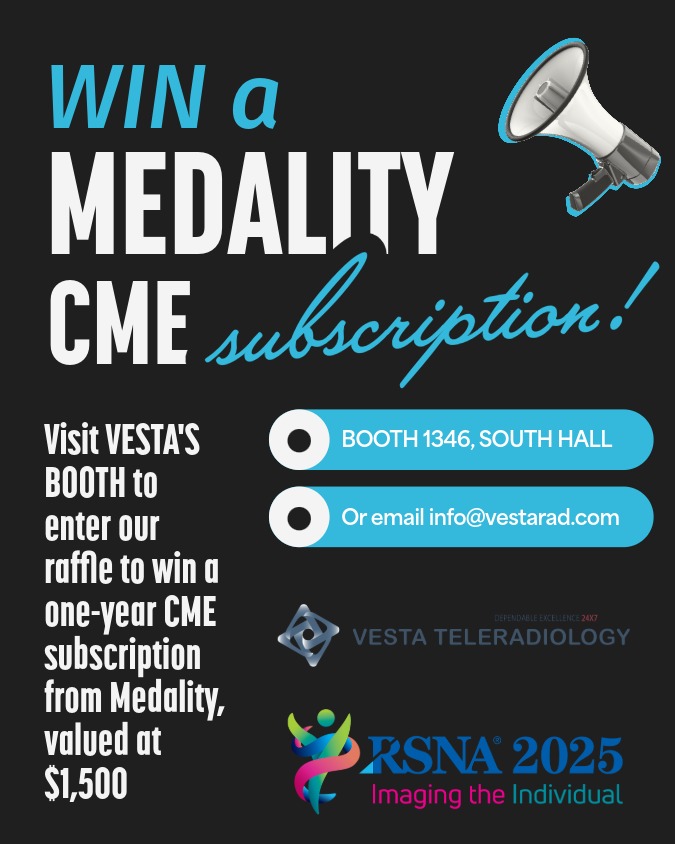
Stop by RSNA 2025 Booth 1346 (South Hall) or email info@vestarad.com with subject “Medality CME Giveaway.” One entry per attendee; winner announced after RSNA.

About Vesta Teleradiology

Vesta provides 24/7 subspecialty reads, customizable coverage models, and seamless workflow integration for health systems, imaging centers, and rural hospitals nationwide. Learn more at vestarad.com.