National Doctors’ Day: How Teleradiology Supports Physicians Behind the Scenes

Every year on March 30, National Doctors’ Day recognizes the skill, commitment, and daily impact of physicians across the country. The American Medical Association describes it as an annual observance honoring physicians’ dedication to delivering high-quality care. In 2026, that recognition feels especially important as hospitals and health systems continue to manage physician shortages, growing imaging demand, and the pressure to maintain fast, high-quality care across every hour of the day.

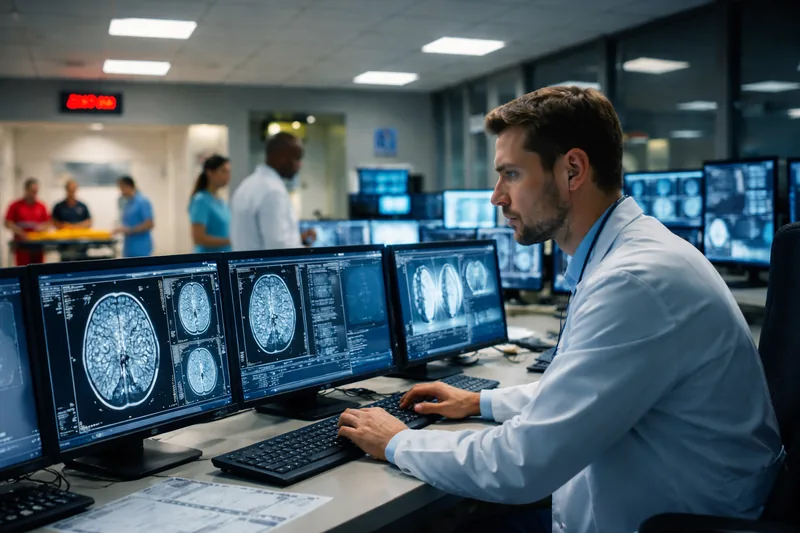
When people think about physicians on the front lines, they often picture emergency medicine doctors, hospitalists, surgeons, and specialists seeing patients in person. But radiologists are physicians too, and behind the scenes, they play a major role in helping those care teams move patient care forward. Through teleradiology, that expertise can reach hospitals, imaging centers, and providers whenever it is needed most.

fda-cleared xray

For many hospitals, especially those needing overnight, weekend, holiday, or subspecialty coverage, teleradiology is one of the support systems that helps physicians make timely decisions with greater confidence. Vesta Teleradiology positions itself as a Joint Commission-accredited, 24/7/365 provider serving hospitals, imaging centers, and health systems nationwide with U.S. board-certified radiologists and subspecialty support.

Helping Physicians Get Answers Faster

For emergency physicians and inpatient teams, waiting on an imaging interpretation can slow down patient flow, delay treatment decisions, and add pressure to an already demanding shift. That is one reason teleradiology matters so much behind the scenes. The right partner helps make sure studies are read promptly, critical findings are surfaced quickly, and referring physicians have the information they need when they need it.

This support is even more meaningful today because physician workforce strain is not easing. AAMC says the United States is projected to face a physician shortage of between 13,500 and 86,000 physicians by 2036, and ACR recently highlighted radiology workforce shortages and rising imaging volumes as a continuing challenge for the field.

Supporting Physicians Beyond After-Hours Coverage

Modern teleradiology is about more than reading cases at night. Hospitals increasingly need dependable coverage models that support physician teams around the clock, fill subspecialty gaps, and integrate smoothly into existing operations. That can mean helping a hospitalist get a faster final interpretation, supporting an ED physician with urgent reads overnight, or giving a facility access to subspecialty expertise that may not be available locally. RSNA has noted that radiology demand continues to outpace radiologist capacity, which adds to the importance of scalable support models.

Vesta’s service positioning reflects that broader support role. The company highlights 24/7 coverage, subspecialty interpretations, support for hospitals and imaging centers, and service across all 50 states.

Why This Matters for Rural and Underserved Communities

National Doctors’ Day is also a good time to recognize the physicians serving rural and underserved communities, where access challenges can be even more severe. Federal telehealth guidance continues to emphasize how telehealth can expand access in rural settings, and HRSA’s telehealth office exists specifically to improve access to quality care through integrated telehealth services.

For imaging, that can translate into meaningful operational support. Teleradiology can help hospitals maintain coverage when local recruiting is difficult, when internal teams need backup, or when subspecialty interpretation is not available onsite. Vesta also specifically connects its AI-assisted imaging strategy to benefits for both large health systems and rural or underserved communities.

The 2026 Angle: AI as a Support Tool, Not a Substitute

Another meaningful part of this discussion is the growing role of AI in helping physicians and radiologists manage workload. In 2026, hospital leaders are asking more practical questions about AI: Can it help prioritize worklists? Can it support faster review? Can it improve workflow without compromising physician oversight?

Powering Quality and Efficiency Through AI

That is the right way to approach it. AI is most useful when it works in support of physicians rather than trying to replace clinical judgment


A Good Time to Recognize the Physicians Behind the Images

Doctors’ Day is not only about the physicians patients see face-to-face. It is also a reminder to appreciate the many physicians working behind the scenes to help every care decision happen. Radiologists, subspecialists, and the teleradiology teams supporting hospital operations are part of that story.

For hospitals in 2026, one of the most practical ways to support physicians is to strengthen the systems around them. Reliable teleradiology coverage, subspecialty access, and AI-enhanced workflow can help reduce bottlenecks, improve responsiveness, and make it easier for physicians to focus on patient care. On National Doctors’ Day, that is a worthwhile reminder: supporting doctors does not only mean celebrating them. It also means giving them the tools, coverage, and partnerships that help them do their jobs well.




Top Qualities to Look for in a Teleradiology Company in the USA in 2026

In 2026, hospitals and imaging providers are looking beyond a vendor that can read studies after hours. They are looking for a teleradiology partner that can help protect turnaround times, expand subspecialty access, support strained radiology teams, and use AI responsibly to improve workflow without replacing radiologist judgment. That shift matters because radiology demand and workforce strain are still real, and healthcare organizations need solutions that are both scalable and clinically reliable. AAMC continues to project a broad U.S. physician shortage by 2036, while RSNA has highlighted ongoing radiologist workforce pressure and rising imaging volume.

So what should modern hospitals look for in a teleradiology company in the USA in 2026?

  1. U.S.-Based, Board-Certified Radiologists

The foundation still matters most. A strong teleradiology company should offer U.S.-based, board-certified radiologists who understand clinical expectations, communication standards, and the realities of American hospital workflows. In a market where speed matters, quality cannot become an afterthought. Vesta partners with U.S. board-certified radiologists, nationwide coverage, and support for hospitals, imaging centers, and urgent care facilities.

  1. Real Subspecialty Coverage, Not Just General Overflow

In 2026, hospitals should look beyond basic overnight reading coverage. They should ask whether a teleradiology company can support subspecialty interpretation when complexity rises. Neuro, body imaging, MSK, emergency imaging, and other focused reads can affect confidence, consistency, and downstream care decisions. Radiology workforce pressure is not evenly distributed, and subspecialty gaps can be especially difficult to fill.

That is why a modern teleradiology partner should be able to deliver both routine coverage and access to deeper expertise when needed.

  1. 24/7/365 Coverage That Holds Up Under Stress

Plenty of companies say they offer around-the-clock service. The better question is whether that coverage remains dependable on nights, weekends, holidays, and during sudden surges in volume. Hospitals should look for a partner with a proven operating model for continuous coverage, not just marketing language about availability. Vesta is proud to offer 24/7/365 support, preliminary and final interpretations, and scalable coverage across the U.S.

That kind of consistency matters because radiology delays can affect ED throughput, inpatient flow, and clinician satisfaction.

  1. AI-Enhanced Workflow That Supports Radiologists

In 2026, AI is no longer a futuristic talking point. It is part of the decision set. But hospitals should be careful about how they evaluate it. The best teleradiology companies use AI to support workflow, triage, prioritization, consistency, and operational efficiency while keeping radiologists in control of interpretation. RSNA publications have noted that AI can improve productivity and support report generation and workflow efficiency, but they also stress that safe deployment, validation, and thoughtful integration are essential. FDA resources likewise show a growing U.S. landscape of AI-enabled medical devices and active regulatory guidance around lifecycle management and safety.

Grayscale radiology AI hero image showing imaging screens and a neural circuit concept representing governance, workflow, and qualityVesta has invested in AI-assisted imaging and workflow partnerships, including Qure.ai, Carpl.ai, and RadPair, as well as internal AI-based support tools that help staff retrieve protocols, schedules, credentialing information, and specialty details more efficiently. Vesta also states that it uses AI-driven prioritization and cloud-based workflow tools to help radiologists surface critical findings faster and return reports without delay.

For hospitals, the takeaway is simple: do not ask whether a teleradiology company uses AI. Ask how it uses AI, where it fits into workflow, and whether it strengthens speed and quality without weakening oversight.

  1. Seamless Integration With Existing Systems

A teleradiology relationship should make operations easier, not harder. That means the company should be able to integrate with PACS, RIS, HL7, and related workflow infrastructure in a way that minimizes friction for staff. Fast onboarding, dependable communication, and technology compatibility should all be part of the evaluation process. Vesta offers HL7 integration, infrastructure support, managed implementation capabilities, and customizable IT solutions as part of its service mix.

The more seamless the operational fit, the faster a facility can realize value.

  1. Support for Rural and Underserved Facilities

Hospitals in rural and underserved areas often feel imaging access problems first. AHRQ has noted that rural communities face provider shortages and may benefit significantly from telehealth-supported care models. Teleradiology can be especially valuable when geography and staffing limitations make local subspecialty access difficult.

Vesta uses AI-enabled radiology expansion as a way to support hospitals of every size, including rural and underserved communities.

  1. Accreditation, Reliability, and Communication

Hospitals should also look for proof of organizational maturity. Accreditation, dependable service, and direct communication pathways all matter. Vesta is a Joint Commission-accredited provider and emphasizes timely, secure interpretations and direct service support.

In practical terms, a strong teleradiology company should be able to answer these questions clearly:

How fast can you onboard us?
Who reads our cases?
What subspecialties do you cover?
How do you handle critical findings?
How does your AI fit into workflow?
How do your radiologists communicate with our team?

The Bottom Line

In 2026, the top qualities to look for in a teleradiology company in the USA go well beyond basic night coverage. Hospitals should prioritize clinical quality, subspecialty depth, dependable 24/7/365 service, strong integration, and AI-enhanced workflow that improves efficiency while preserving radiologist oversight. For organizations trying to protect patient flow, reduce coverage risk, and modernize imaging operations, those qualities are no longer optional. They are the standard modern hospitals should expect from a serious teleradiology partner.


When Radiology Groups Lose Capacity: How Hospitals Can Protect Coverage, Turnaround Times, and Patient Flow

The quiet risk hospitals don’t plan for: capacity collapse

Radiology coverage doesn’t always fail with a formal termination or an obvious “we’re done” message. More often, it erodes. A radiology group loses key radiologists, experiences unexpected attrition, can’t recruit fast enough, or faces scheduling strain that turns into missed commitments. The hospital still has the same ED demand, the same inpatient needs, and the same responsibility to keep care moving—yet turnaround times slip, subspecialty availability narrows, and internal teams get stretched thin.

From an operational standpoint, the impact can look like an “implosion,” even if the root cause is simply capacity mismatch.


What capacity loss looks like in real hospital workflows

When a radiology group is underwater, the warning signs typically show up as workflow symptoms before anyone names the problem:

  • Growing backlogs during evenings, nights, or weekends
  • Longer final-report turnaround times, especially for CT and MR
  • Reduced subspecialty coverage (neuro, MSK, body, breast)
  • More “wet reads,” delayed overreads, or inconsistent staffing patterns
  • Slower critical result communication and more escalations to leadership
  • Increasing reliance on a small number of radiologists to “save the shift”

None of these are just radiology issues. They affect ED throughput, length of stay, patient satisfaction, and clinician trust.


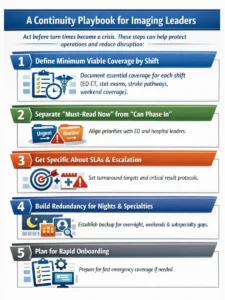
A continuity playbook for imaging leaders infographic with five steps: define minimum viable coverage by shift, separate must-read now from can phase in, set SLAs and escalation, build redundancy for nights/weekends/subspecialty reads, and plan rapid onboarding.

Hospitals are seeing pressure from multiple directions at once: staffing shortages, increasing exam complexity, heavier after-hours demand, and rising expectations for consistent turn times. One indicator the market is under strain: a Neiman Health Policy Institute analysis found that from 2014–2023, the number of practices with affiliated radiologists fell 14.7% while the number of radiologists grew 17.3%, reflecting ongoing consolidation and shifting coverage capacity.” When a group loses even a few radiologists—especially subspecialists—the coverage math can break quickly. Recruiting is rarely immediate, and internal coverage often becomes a patchwork of short-term fixes.


The important takeaway is this: a capacity disruption doesn’t require bad intent to create real clinical and operational risk. That’s why continuity planning matters.


A continuity playbook for imaging leaders

If you suspect your group is approaching a capacity shortfall, the best time to act is before turn times become a crisis. These steps can help protect operations and reduce disruption:

1) Define minimum viable coverage by shift

Document what must be covered on each shift to protect patient flow (e.g., ED CT, inpatient stat, stroke pathways, weekend coverage). This gives you a clear baseline if you need a stopgap plan.


2) Separate “must-read now” from “can phase in”

Not every study needs the same priority level. Align with ED and hospital leadership on what requires immediate final reads vs. what can be scheduled with acceptable delay.

3) Get specific about SLAs and escalation

If turn times are drifting, vague expectations won’t fix it. Define turnaround targets by priority category and document critical-result escalation pathways so the burden doesn’t land on one manager’s phone.

4) Build redundancy for nights, weekends, and subspecialty reads

Capacity collapses often reveal the weakest links first: overnight coverage, weekend staffing, and subspecialty depth. Even if you don’t outsource everything, having a backup partner for the riskiest windows can stabilize operations.

5) Plan for rapid onboarding before you need it

The fastest transitions happen when leadership has already identified what they’d need for an emergency coverage start: modality volumes, hours, PACS/RIS details, dictation preferences, and communication protocols.


How Vesta supports hospitals when coverage is strained or service is disrupted

When a radiology group can’t keep up, hospitals need dependable coverage that restores momentum—not another layer of complexity. Vesta Teleradiology helps facilities stabilize quickly with a continuity-first approach:

  • Scalable capacity to absorb surges and protect turn times
  • Subspecialty interpretation options aligned to case complexity
  • Clear expectations for turnaround and critical results communication
  • Rapid onboarding pathways designed for real hospital workflows

Whether you need temporary stabilization, overflow coverage, nights/weekends support, or a longer-term solution, we can tailor coverage so your imaging team isn’t forced into constant triage mode.


Every staffing disruption has context. The point isn’t to assign blame—it’s to protect continuity of care and keep clinical operations stable. If your facility is seeing warning signs of coverage strain, we can help you assess options and timelines without speculation about any third party.