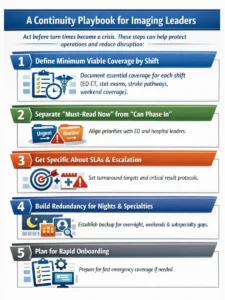
When hospital leaders evaluate radiology coverage, turnaround time is often one of the first numbers discussed. Yet a single promised turnaround time tells only part of the story.
An effective radiology turnaround time SLA should define how studies are prioritized, what happens when volume rises unexpectedly, how critical findings are communicated, and how performance is measured over time.
Those questions are becoming increasingly important as imaging demand continues to put pressure on radiology departments. In a 2026 workforce update, the American College of Radiology reported projections showing imaging demand continuing to rise alongside a radiologist workforce that may struggle to keep pace. ACR cited projected growth through 2055 of approximately 17% for MRI and 25% for CT, depending on modality and workforce assumptions.
More recently, ACR leadership reiterated in June 2026 that demand for imaging care remains strong and is expected to grow at least as fast as the radiology workforce.
For hospitals already managing busy emergency departments, overnight studies, subspecialty needs, and unpredictable surges, this makes thoughtful SLA design increasingly valuable.
STAT, Urgent, and Routine Studies Need Different Expectations
Treating every examination as equally urgent can create workflow problems of its own. A useful SLA establishes clearly defined study priorities.
STAT studies typically involve situations where clinicians need a rapid interpretation to make an immediate care decision. Emergency neurological imaging, trauma studies, suspected pulmonary embolism, and other time-sensitive examinations may fall into this category according to a facility’s protocols.
Urgent studies require expedited interpretation but may operate within a different turnaround window.
Routine studies often permit more flexibility and can be distributed across the worklist in a way that preserves capacity for genuinely time-sensitive cases.
The exact thresholds should be established between the healthcare organization and its radiology provider based on clinical requirements, available resources, service lines, and patient population.
The important point is clarity. Everyone involved should understand how an examination becomes STAT, how it enters the worklist, and what occurs when expected turnaround is at risk.
Turnaround Time Begins Before the Radiologist Opens the Study
Hospitals sometimes focus on interpretation time while overlooking delays elsewhere in the imaging chain.
A study can be slowed by incomplete transmission, missing prior examinations, incorrect routing, insufficient clinical history, connectivity problems, or a worklist configuration that sends the examination to the wrong queue.
This is why a strong SLA should consider the entire radiology workflow.
- How are incoming studies prioritized and routed?
- Can studies be assigned according to modality or subspecialty?
- What happens during an unexpected volume surge?
- How are delayed studies identified?
- Who receives an escalation when turnaround expectations are threatened?
- How are technical problems handled overnight?
- How frequently is performance reviewed?
These questions reveal considerably more about operational reliability than a single advertised turnaround number.
Critical Findings Require a Communication Process
Fast interpretation has limited value if an important finding does not reach the right clinician.
The ACR Practice Parameter for Communication of Diagnostic Imaging Findings emphasizes that effective communication depends on the system through which information is conveyed and recognizes shared responsibilities surrounding the receipt and appropriate handling of imaging results.
That makes critical-result communication an important component of an SLA.
Hospitals should establish who must be contacted, which communication channels are approved, how receipt is documented, when escalation occurs, and who serves as the backup contact.
This becomes particularly important overnight, when daytime department leaders may be unavailable and clinical teams are working with smaller staffs.
Capacity Planning Belongs in the SLA Discussion
A turnaround commitment made during normal volume tells hospital administrators little about what will happen during a surge.
Emergency department demand can change rapidly. Seasonal illness, trauma, staffing vacancies, radiologist PTO, equipment expansion, and new service lines can all increase the reading workload.
Recent ACR analysis of radiology workforce economics described practices dealing with uneven subspecialty coverage and chronic backlogs. In one example, redesigning coverage around capability and centralized subspecialty pools generated an additional 10% of effective capacity without adding headcount.
The broader lesson for hospitals is straightforward: workflow design matters.
A teleradiology arrangement can provide additional flexibility through overflow coverage, Nighthawk coverage, subspecialty reading support, or combinations of these services.
Instead of waiting for the worklist to become unmanageable, facilities can establish thresholds for activating additional reading capacity.
Measure More Than the Average
Average turnaround time can conceal operational problems.
Imagine that 95 examinations are reported rapidly while five high-priority studies experience significant delays. The overall average may still look excellent.
Useful performance reviews can examine SLA compliance by priority level, modality, shift, facility, or service line. Administrators can also look at outliers and escalation events rather than relying solely on averages.
The objective is to understand where workflow pressure develops and address it before isolated delays become recurring problems.
Building a More Reliable Radiology Coverage Model
A strong radiology SLA connects clinical priorities with operational reality.
For hospitals, community facilities, imaging centers, and urgent care organizations, that means considering volume patterns, operating hours, modality mix, subspecialty requirements, after-hours demand, and escalation procedures when establishing coverage.
Vesta Teleradiology provides 24/7 nationwide teleradiology services, including Nighthawk, overflow, and subspecialty interpretation by U.S. board-certified radiologists. Coverage can be structured around the workflow and requirements of each facility.
Frequently Asked Questions
What is a radiology turnaround time SLA?
A radiology turnaround time SLA defines agreed-upon service expectations between a healthcare organization and its radiology provider. It may include turnaround targets by study priority, communication procedures, escalation processes, coverage hours, and performance reporting.
Should STAT and routine imaging have the same turnaround target?
Generally, facilities establish different priorities according to clinical urgency. The specific turnaround expectations should reflect the hospital’s protocols, patient population, staffing model, and clinical requirements.
Can teleradiology help hospitals manage turnaround times during volume surges?
Teleradiology can provide supplemental reading capacity when internal teams face increased volume, overnight demand, vacancies, or unexpected staffing constraints. Overflow arrangements can be customized around a facility’s needs.
Need to strengthen radiology coverage or prepare for changing imaging volume? Contact Vesta Teleradiology to discuss a coverage model built around your facility’s workflow.
Sources