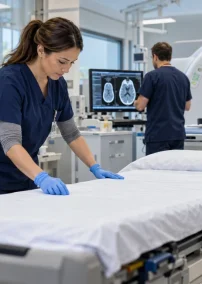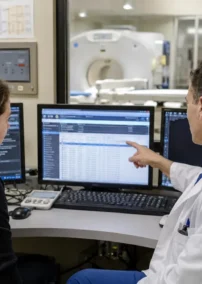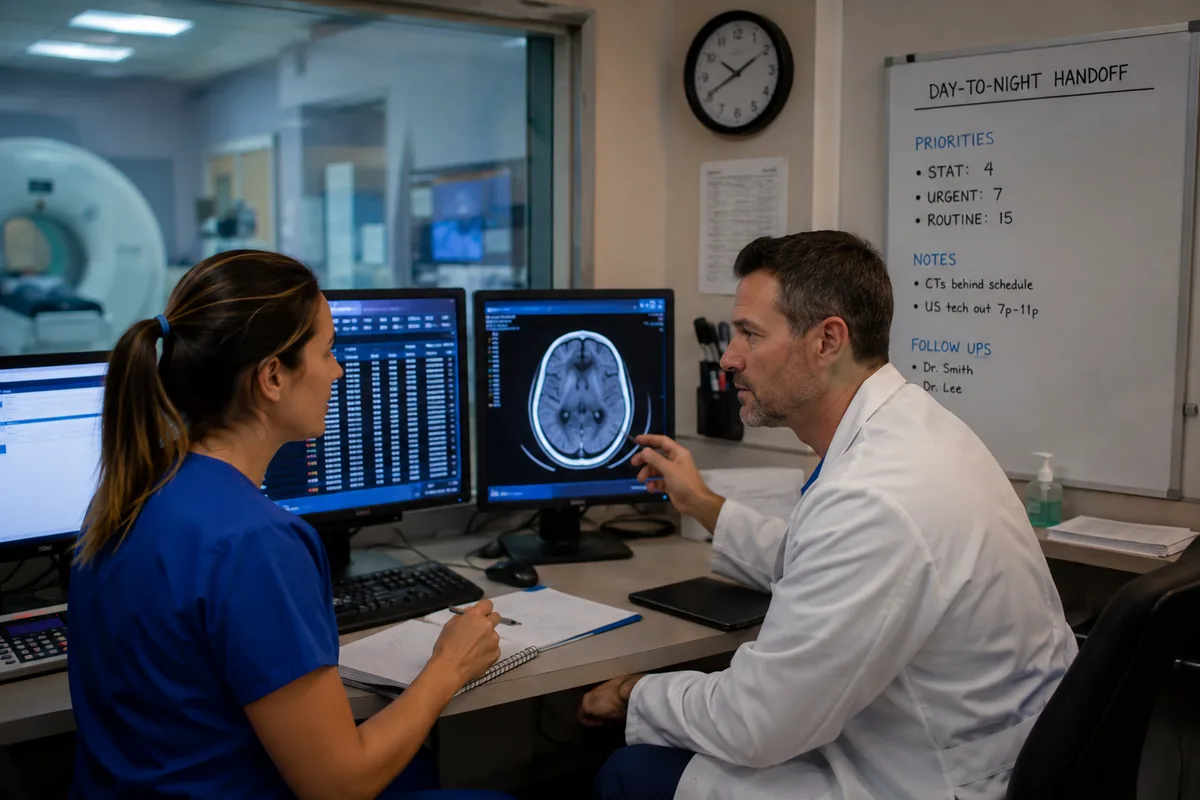
At 6:59 p.m., a hospital radiology department may appear to be operating normally. At 7:01, responsibility for dozens of imaging studies can begin shifting to a different team.
That transition deserves more attention than it often receives.
For hospitals using Nighthawk radiology coverage, the quality of the day-to-night handoff can influence how smoothly studies are routed, how quickly priority examinations are identified, how critical findings are communicated, and what the daytime team encounters the next morning.
The issue has broader significance as imaging demand continues to grow. In June 2026, American College of Radiology leadership described imaging demand as stronger than ever while the radiology workforce remains tight, with projections indicating imaging demand could grow at least as quickly as the available workforce.
That environment makes continuity between shifts increasingly important.
A Radiology Handoff Is More Than Changing Readers
Healthcare handoffs involve transferring information along with responsibility.
The Agency for Healthcare Research and Quality describes a handoff as a standardized process for transferring information, authority, and responsibility during transitions in care. AHRQ also highlights the opportunity for the receiving team to review information and ask questions.
In radiology, the transition may involve an internal evening team, an overnight radiologist, or an outside teleradiology service.
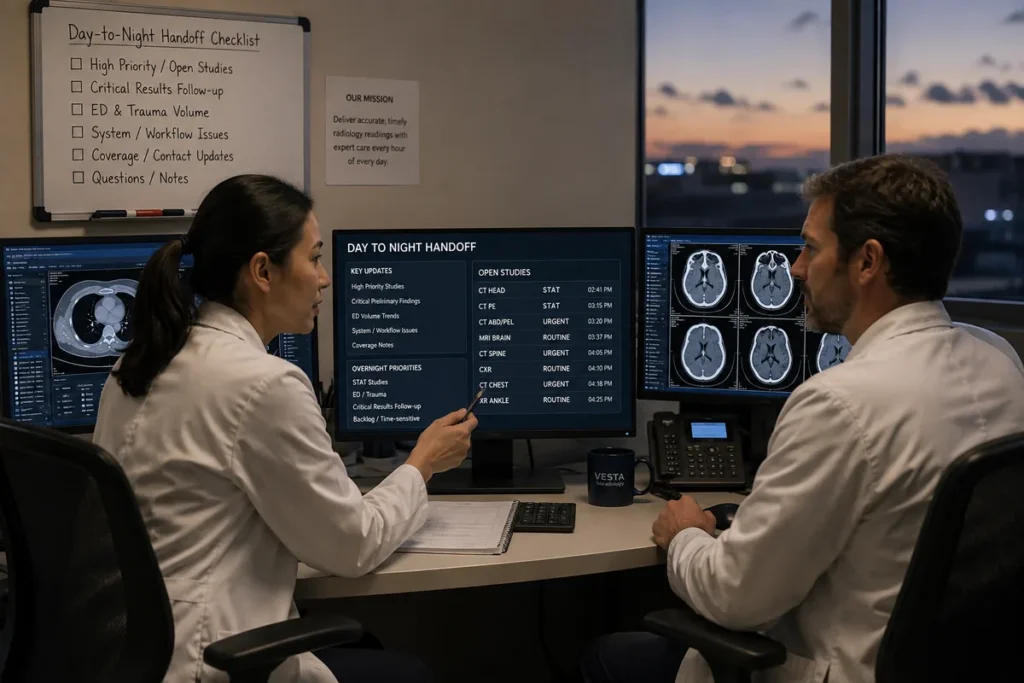
A strong transition establishes what is currently in the queue, what deserves immediate attention, which examinations are pending, and how communication will work for the remainder of the shift.
The Overnight Team Needs an Accurate View of the Worklist
The first requirement is visibility.
The incoming radiology team should be able to identify studies according to priority, modality, facility, and other applicable routing criteria.
Pending studies should not disappear between queues during the transition.
Facilities using a teleradiology service should verify which examinations automatically route to overnight coverage and which remain with the internal group. If different services cover CT, MRI, X-ray, ultrasound, or specialty examinations, those routing rules should be clear before the shift begins.
A predictable process reduces manual sorting and gives radiologists more time to focus on interpretation.
Pending Cases Need Clear Ownership
One of the simplest questions during a handoff is also one of the most important: Who owns this study now?
A case may have been acquired before the overnight coverage window while still awaiting interpretation when the shift changes. Another study may already be opened by a daytime reader. An examination may require comparison with priors that have not yet arrived.
Defined ownership keeps these cases from sitting in an ambiguous middle ground.
Facilities can establish rules describing when responsibility transfers and how exceptions are communicated.
This becomes especially valuable during high-volume periods when dozens of studies may cross the shift boundary.
Critical-Result Communication Must Continue Seamlessly
Overnight radiology frequently supports emergency departments and inpatient services where time-sensitive findings are common.
The communication process therefore cannot depend on a daytime contact list that becomes obsolete after business hours.
The ACR Practice Parameter for Communication of Diagnostic Imaging Findings emphasizes that communication is only as effective as the system carrying the information. The guidance also recognizes responsibilities surrounding receipt and appropriate action on imaging results.
Hospitals using Nighthawk coverage should establish after-hours primary and backup contacts, escalation pathways, approved communication channels, and documentation procedures.
ACR also notes that certain critical imaging findings may require communication very rapidly after image review.
That makes overnight contact information part of the clinical workflow rather than an administrative detail.
Subspecialty Needs Should Be Visible Before They Become Bottlenecks
The overnight worklist does not always consist of straightforward emergency CT examinations.
Hospitals may encounter complex neurological studies, body imaging, musculoskeletal cases, pediatric studies, or other examinations that benefit from subspecialty expertise.
The current radiology workforce environment makes this particularly relevant. ACR’s 2026 workforce analysis reports that subspecialty availability varies and that imaging volumes have been growing faster than the number of radiologists.
Hospitals can use teleradiology networks to broaden access to subspecialty expertise, particularly when maintaining every specialty on site around the clock would be impractical.
Routing rules established in advance can help appropriate examinations reach radiologists with relevant expertise.
The Morning Handoff Matters Too
Good Nighthawk coverage should also prepare the daytime team for what comes next.
Hospitals should know which overnight studies were completed, whether any examinations remain pending, whether critical findings were communicated, and whether technical or workflow issues occurred.
For organizations using preliminary interpretations, the process should clearly define how finalization or discrepancy management occurs. Facilities using final overnight interpretations require a different morning workflow.
Either model benefits from clear documentation and visibility.
The goal is a morning worklist that reflects what actually happened overnight rather than requiring the daytime team to reconstruct the previous shift.
Build Around Volume Changes
Overnight demand is rarely identical every night.
Weekend activity, holidays, seasonal illness, emergency department surges, local events, staffing changes, and unexpected trauma can alter the worklist rapidly.
This is one reason flexible reading capacity can be valuable. Hospitals can combine scheduled Nighthawk coverage with overflow support so additional volume has somewhere to go when the primary worklist becomes strained.
The wider workforce picture suggests this flexibility will remain relevant. ACR’s current projections show sustained pressure as imaging demand and workforce capacity continue to evolve together.
Designing Better Overnight Radiology Coverage
A reliable day-to-night handoff combines technology, physician coverage, routing, communication, and defined accountability.
Vesta Teleradiology provides 24/7 nationwide radiology support, including Nighthawk coverage, overflow support, and subspecialty reads from U.S. board-certified radiologists. Coverage can be customized around a hospital’s volume, modalities, schedule, and workflow requirements.
Frequently Asked Questions
What is Nighthawk teleradiology?
Nighthawk teleradiology provides remote radiology interpretation during overnight or after-hours periods, helping hospitals maintain access to radiologists when their daytime teams are unavailable or require additional support.
What should be included in a radiology shift handoff?
A facility should establish clear study ownership, worklist routing, priority identification, pending-study procedures, critical-results communication, escalation contacts, subspecialty routing, and morning follow-up processes.
Can Nighthawk services provide final radiology reports?
Coverage structures vary by facility and provider arrangement. Hospitals should define whether overnight studies receive preliminary or final interpretations during contracting and onboarding and build the handoff process accordingly.
Need more dependable overnight radiology coverage? Contact Vesta Teleradiology to discuss Nighthawk, overflow, and customized 24/7 support for your facility.
Sources
- American College of Radiology — Radiologists Will Adapt
- AHRQ TeamSTEPPS — Handoff Tool
- ACR Practice Parameter for Communication of Diagnostic Imaging Findings
- American College of Radiology — Referring Physician / Imaging Value Chain
- American College of Radiology — Radiologist Shortage Workforce Update