
When Radiology Groups Lose Capacity: How Hospitals Can Protect Coverage, Turnaround Times, and Patient Flow

The quiet risk hospitals don’t plan for: capacity collapse

Radiology coverage doesn’t always fail with a formal termination or an obvious “we’re done” message. More often, it erodes. A radiology group loses key radiologists, experiences unexpected attrition, can’t recruit fast enough, or faces scheduling strain that turns into missed commitments. The hospital still has the same ED demand, the same inpatient needs, and the same responsibility to keep care moving—yet turnaround times slip, subspecialty availability narrows, and internal teams get stretched thin.

From an operational standpoint, the impact can look like an “implosion,” even if the root cause is simply capacity mismatch.


What capacity loss looks like in real hospital workflows

When a radiology group is underwater, the warning signs typically show up as workflow symptoms before anyone names the problem:

  • Growing backlogs during evenings, nights, or weekends
  • Longer final-report turnaround times, especially for CT and MR
  • Reduced subspecialty coverage (neuro, MSK, body, breast)
  • More “wet reads,” delayed overreads, or inconsistent staffing patterns
  • Slower critical result communication and more escalations to leadership
  • Increasing reliance on a small number of radiologists to “save the shift”

None of these are just radiology issues. They affect ED throughput, length of stay, patient satisfaction, and clinician trust.
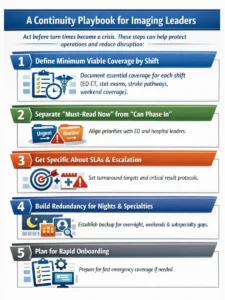
 

A continuity playbook for imaging leaders infographic with five steps: define minimum viable coverage by shift, separate must-read now from can phase in, set SLAs and escalation, build redundancy for nights/weekends/subspecialty reads, and plan rapid onboarding.

Hospitals are seeing pressure from multiple directions at once: staffing shortages, increasing exam complexity, heavier after-hours demand, and rising expectations for consistent turn times. One indicator the market is under strain: a Neiman Health Policy Institute analysis found that from 2014–2023, the number of practices with affiliated radiologists fell 14.7% while the number of radiologists grew 17.3%, reflecting ongoing consolidation and shifting coverage capacity.” When a group loses even a few radiologists—especially subspecialists—the coverage math can break quickly. Recruiting is rarely immediate, and internal coverage often becomes a patchwork of short-term fixes.


The important takeaway is this: a capacity disruption doesn’t require bad intent to create real clinical and operational risk. That’s why continuity planning matters.


A continuity playbook for imaging leaders

If you suspect your group is approaching a capacity shortfall, the best time to act is before turn times become a crisis. These steps can help protect operations and reduce disruption:

1) Define minimum viable coverage by shift

Document what must be covered on each shift to protect patient flow (e.g., ED CT, inpatient stat, stroke pathways, weekend coverage). This gives you a clear baseline if you need a stopgap plan.


2) Separate “must-read now” from “can phase in”

Not every study needs the same priority level. Align with ED and hospital leadership on what requires immediate final reads vs. what can be scheduled with acceptable delay.

3) Get specific about SLAs and escalation

If turn times are drifting, vague expectations won’t fix it. Define turnaround targets by priority category and document critical-result escalation pathways so the burden doesn’t land on one manager’s phone.

4) Build redundancy for nights, weekends, and subspecialty reads

Capacity collapses often reveal the weakest links first: overnight coverage, weekend staffing, and subspecialty depth. Even if you don’t outsource everything, having a backup partner for the riskiest windows can stabilize operations.

5) Plan for rapid onboarding before you need it

The fastest transitions happen when leadership has already identified what they’d need for an emergency coverage start: modality volumes, hours, PACS/RIS details, dictation preferences, and communication protocols.


How Vesta supports hospitals when coverage is strained or service is disrupted

When a radiology group can’t keep up, hospitals need dependable coverage that restores momentum—not another layer of complexity. Vesta Teleradiology helps facilities stabilize quickly with a continuity-first approach:

  • Scalable capacity to absorb surges and protect turn times
  • Subspecialty interpretation options aligned to case complexity
  • Clear expectations for turnaround and critical results communication
  • Rapid onboarding pathways designed for real hospital workflows

Whether you need temporary stabilization, overflow coverage, nights/weekends support, or a longer-term solution, we can tailor coverage so your imaging team isn’t forced into constant triage mode.


Every staffing disruption has context. The point isn’t to assign blame—it’s to protect continuity of care and keep clinical operations stable. If your facility is seeing warning signs of coverage strain, we can help you assess options and timelines without speculation about any third party.

Celebrating National Health Center Week: The Frontline of Community Care

Every August, National Health Center Week (August 3-9 2025) recognizes the critical role community health centers play in delivering affordable, high-quality healthcare across the United States. These centers serve more than 30 million patients annually, many of whom live in medically underserved or rural regions. But as demand for comprehensive care grows, so does the need for accessible diagnostic imaging—an area where teleradiology is helping bridge the gap.

The Imaging Gap in Rural and Underserved Areas

Access to diagnostic imaging remains a persistent challenge for many community health centers. Facilities in rural or low-resource areas often face:

  • Limited access to on-site radiologists
  • Delays in turnaround times for imaging reads
  • Difficulty recruiting or retaining subspecialty radiologists
  • Rising imaging volumes due to expanded preventive care

These barriers can compromise patient outcomes, especially in time-sensitive cases involving stroke, cancer screening, or trauma. Imaging is a critical step in diagnosis—and delays in radiology reports can delay treatment.

Teleradiology: A Scalable Solution for Imaging Access

Teleradiology enables healthcare facilities to send medical images (like X-rays, CT scans, MRIs, and mammograms) electronically to off-site, board-certified radiologists for interpretation. For community health centers, this technology is transformative.

Here’s how teleradiology supports health centers during National Health Center Week and year-round:

  1. 24/7 Coverage, Including Nights and Holidays
    Teleradiology ensures that community health centers can offer imaging services around the clock—even if there’s no radiologist physically on-site. This is especially important for urgent care and emergency settings in rural hospitals.

  2. Access to Subspecialty Reads
    Facilities may not always have access to neuroradiologists, MSK radiologists, or breast imaging specialists. Vesta Teleradiology offers access to subspecialty reads, ensuring every case is interpreted by the right expert.

  3. Faster Turnaround Times
    With cloud-based image transfer and structured reporting, teleradiology reduces delays and improves turnaround times. That means faster results, quicker clinical decisions, and better patient care.

  4. Support for Preventive Imaging Initiatives
    Community health centers are expanding their use of imaging for preventive care—particularly for breast cancer screening, lung health, and cardiovascular risk. Teleradiology provides scalable support during screening campaigns or high-volume periods.

    Female patient undergoing a mammogram with a radiologic technologist in a medical exam room

  5. Cost-Effective Radiology Staffing
    Teleradiology helps optimize budgets by supplementing in-house radiologists or replacing expensive on-call coverage. Flexible pricing models ensure services align with facility needs and patient volume.

Why Imaging Access Matters More Than Ever

The need for diagnostic imaging continues to rise in 2025. According to recent projections from the Harvey L. Neiman Health Policy Institute, demand for imaging will grow at a faster rate than the radiologist workforce through 2055. In rural and medically underserved areas, the shortage is even more pronounced.

Community health centers are on the front lines of closing this gap. But without reliable imaging access, they face limitations in diagnosis, monitoring, and treatment planning.

How Vesta Teleradiology Helps Health Centers Thrive

At Vesta, we understand the pressures community health centers face. That’s why we offer:

  • Fully customizable radiology services tailored to your patient population
  • Rapid onboarding and seamless PACS integration
  • Weekend, holiday, and night coverage
  • A team of U.S.-based, board-certified radiologists
  • Subspecialty interpretations across all major imaging fields

Whether you’re a rural clinic needing full radiology coverage or a mid-sized health center looking for overflow support, our teleradiology solutions are built to help you scale—without compromising care quality.

Join the Movement: National Health Center Week

National Health Center Week is more than a celebration. It’s a reminder that access, equity, and quality care start with supporting the providers who serve our most vulnerable populations. Teleradiology is a powerful tool to help meet that mission.

If your health center is planning to expand imaging services or looking for reliable radiology coverage, Vesta is here to help.

Let’s build healthier communities—one accurate read at a time.


Mid-Year Radiology Trends: What’s Shaping Diagnostic Imaging in 2025

The pace of change in radiology and diagnostic imaging only accelerated in 2025. From emerging technologies to new ways of working, the field is evolving rapidly to meet both growing patient demand and the ongoing challenge of radiologist shortages.

Here’s a look at the key mid-year trends shaping radiology so far this year—and how facilities can stay ahead with the right partners.


  1. AI Is Evolving—But Radiologists Remain at the Center

AI tools in radiology are becoming more sophisticated, particularly in automating administrative tasks like report generation, triage, and workflow optimization.

A recent article from Business Insider noted that many radiologists now use generative AI to streamline productivity—not replace their diagnostic expertise. The key is finding the right balance: AI assists, but human interpretation remains critical.

At Vesta Teleradiology, our board-certified radiologists embrace AI tools that improve speed and accuracy while maintaining clinical oversight and patient safety.


  1. Staffing Pressures Continue—and Teleradiology Bridges the Gap

Radiologist shortages are still a frontline issue in 2025. The Neiman Health Policy Institute projects the shortage will persist through 2055 without proactive changes. This strain is particularly acute in oncology and rural hospitals, where delays in imaging results can directly impact outcomes.

Teleradiology is now an essential solution for many facilities. At Vesta, we provide:
✅ 24/7/365 STAT & routine reads
✅ Subspecialty support (Neuro, MSK, Cardiac, Pediatrics, and more)
✅ No minimum read requirements
✅ Customizable workflows to fit your needs


  1. Photon-Counting CT: A Game-Changer for Imaging

Photon-counting CT (PCCT) is gaining traction in 2025, offering higher resolution images with lower radiation doses. Early adopters are seeing promising results in cardiovascular and oncologic imaging.

As new modalities enter clinical use, having expert radiologists trained in advanced imaging techniques is vital. Vesta’s subspecialty readers are ready to interpret the most complex cases with precision.

  1. The Rise of Digital Twins in Imaging

Digital twins—virtual models of patients—are becoming more practical in healthcare. Radiology plays a key role by providing the high-fidelity imaging needed to create these models for personalized medicine, treatment planning, and disease monitoring.

As these technologies develop, facilities will need radiologists with the expertise to interpret increasingly complex imaging data—and flexible partners to help scale their capabilities.


  1. Growing Focus on Turnaround Times and Patient Experience

With patients and referring physicians expecting faster results, facilities are under pressure to reduce turnaround times—especially for oncology, trauma, and screening programs.

Vesta Teleradiology helps meet this demand with:

  • 24/7 availability to prevent backlogs
  • Real-time communication for critical findings
  • Customizable reporting to fit your workflow and brand


Conclusion: How to Stay Ahead in a Fast-Moving Year

The radiology landscape is dynamic—and staying ahead requires agility, expertise, and trusted partners. Whether you’re looking to bridge staffing gaps, scale subspecialty reads, or handle advanced imaging modalities, Vesta Teleradiology is here to help.

Our U.S.-based, board-certified radiologists deliver precision reads with flexible, scalable solutions for hospitals, imaging centers, and healthcare systems nationwide.

Let’s connect today to customize a radiology solution that fits your 2025 needs—and beyond.

Contact Vesta Teleradiology.


Sources:

Business Insider
arXiv.org 
arXiv.org 
The Imaging Wire