Radiology AI in 2026: From “Cool Tools” to Governance, Workflow & Quality

In 2026, the radiology AI conversation is shifting from “Which algorithm is best?” to “How do we run AI in production without creating new risks or new bottlenecks?” Hospitals and imaging leaders are under pressure to improve turnaround times, reduce backlogs, and keep quality consistent—yet everyone knows that technology layered onto an already complex workflow can backfire if it isn’t governed properly.

The most successful AI programs aren’t defined by a single tool. They’re defined by governance, interoperability, and measurable performance—and by a workflow design that supports radiologists rather than fragmenting their attention.

Why AI success looks different in 2026

Early AI adoption often focused on point solutions: a triage tool here, a detection aid there. Today, organizations want outcomes: faster reads, fewer misses, more consistent reporting, and fewer operational disruptions. That’s why governance is taking center stage. The American College of Radiology (ACR) has emphasized the need for formal AI governance and oversight structures to keep patient safety and reliability at the forefront.

At the same time, the industry is pushing hard on interoperability—making sure AI tools integrate into PACS/RIS and clinical communication rather than living in “yet another dashboard.” RSNA has showcased how workflow integration and standards can reduce friction points and help AI support real clinical scenarios.

The 2026 AI governance checklist (simple, practical, usable)

Whether you’re adopting your first tool or scaling across modalities, governance doesn’t need to be complicated—but it does need to be real. A strong governance model typically includes:

1) Clear clinical ownership

AI cannot be “owned by IT.” Radiology leaders should define:

  • Where AI is allowed to influence priority or interpretation

  • When radiologists can override AI outputs (and how overrides are documented)

  • What happens when AI and clinical suspicion conflict

2) Validation before scale

Before broad rollout, validate performance in your setting:

  • Scanner/protocol differences

  • Patient population differences

  • Volume and study mix differences

Even a great algorithm can underperform when protocols change or volumes surge.

3) Ongoing monitoring for drift

AI isn’t “install and forget.” Real-world performance changes over time—new scanners, new protocols, and shifting patient demographics can all cause drift. That’s why long-term monitoring is a growing focus in radiology AI standards efforts. For example, ACR has discussed practice parameters and programs aimed at integrating AI safely into clinical practice.

4) Operational metrics that matter

Track the metrics your hospital actually feels:

  • ED and inpatient turnaround time (TAT)

  • Backlog hours by modality

  • Discrepancy rates and peer-review signals

  • Percentage of cases escalated via triage

  • Radiologist interruption load (alerts, worklist reshuffles)

If AI improves one metric by harming another, it’s not a net win.

Where Vesta fits: AI + subspecialty reads + QA

For many hospitals, the most practical 2026 strategy isn’t “AI replaces humans.” It’s AI improves routing and prioritization, while subspecialty radiologists deliver the interpretation quality that clinical teams depend on.

A common best-practice workflow looks like this:

  • AI supports triage and worklist prioritization (especially for time-sensitive pathways)

  • Subspecialty radiologists provide consistent, high-confidence reads

  • QA processes (peer review, discrepancy tracking, feedback loops) ensure reliability over time

That combination is how you get the real goal: speed and confidence together—not speed at the expense of quality.

What to do next

If you’re building or refining an AI program in 2026, start with your workflow map—then add tools where they reduce friction. And make sure governance is designed before adoption accelerates.

If your team needs scalable subspecialty coverage to support operational goals (nights/weekends, overflow, or targeted service lines), Vesta Teleradiology can help you build a coverage model that keeps reads moving without sacrificing consistency. Learn more at https://vestarad.com.

What Is Medality—and Why a One-Year Membership Is a Big Win for Radiologists

If you’ve heard colleagues mention “MRI Online,” you’ve already met Medality—the platform’s new name and broader vision for case-based radiology education and CME. Medality

Medality offers a large, searchable library of subspecialty courses and real cases designed for busy readers. The program is ACCME-accredited to provide AMA PRA Category 1 Credits™, with 700+ hours available to claim—so credits count toward common licensure, MOC, and credentialing needs. (For context on AMA PRA Category 1 Credit™ and ACCME alignment, see AMA/ACCME guidance.) American Medical Association


What makes Medality valuable in day-to-day practice

Case-based, time-efficient learning. The library is built around short, expert-led “microlearning” lessons you can fit between cases—so you steadily upskill without disrupting coverage.

Hands-on practice with scrollable DICOMs. Medality’s case archive includes fully scrollable CT/MR studies plus brief video explanations and quizzes, helping sharpen detection speed and reporting confidence on high-yield findings.

Depth across subspecialties. From neuro and MSK to breast, cardiac, ED and beyond, courses and case sets let you target the areas your case mix demands most.

Accredited CME you’ll actually use. With 700+ AMA PRA Category 1 Credits™ available (and more added regularly), radiologists can chip away at requirements continuously rather than scrambling at renewal time.

MEDALITY CMEWhy this RSNA prize matters for teams—not just individuals

Training without lost coverage. Because lessons are on-demand and bite-sized, radiologists can learn after hours or between reads, preserving TAT while still building subspecialty confidence.

Goal-aligned upskilling. If your facility is seeing more chest pain workups, stroke alerts, or MSK injuries, you can steer readers to focused tracks and track progress via CME claims over the year.

Credentialing peace of mind. AMA PRA Category 1 Credit™ is widely accepted across hospitals and state boards, making a one-year membership a practical asset for QA plans and reappointments. (See the AMA/ACCME alignment noted above.) American Medical Association

“Is it really a $1,500 value?”

Medality’s public promos frequently reference savings or membership values up to $1,500 on premium or multi-year packages—useful as a benchmark for how substantial a full-year membership is compared with typical online CME.

Where Medality complements Vesta’s AI-enabled reading

Vesta blends subspecialty expertise with a pragmatic partner-plus-platform AI approach—dictation, PACS/VNA, and algorithm marketplaces—to deliver predictable quality and TAT. Continuous learning via Medality strengthens the skills behind that workflow, while Vesta’s operations and AI strengthen the throughput—a combined, durable path to better patient care.

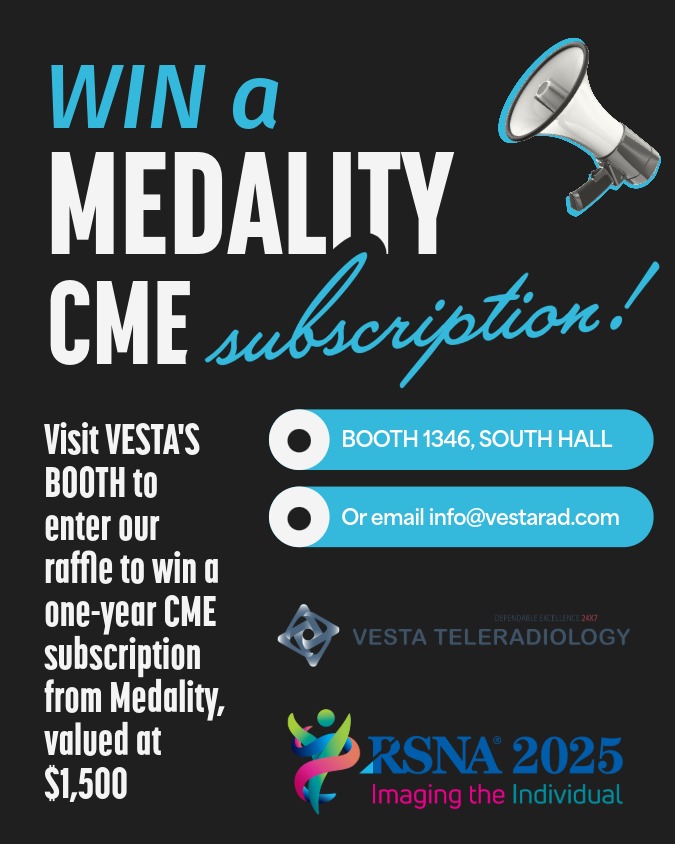
How to enter the giveaway
Stop by RSNA 2025 Booth 1346 (South Hall) or email info@vestarad.com with subject “Medality CME Giveaway.” One entry per attendee; winner announced after RSNA.

About Vesta Teleradiology

Vesta provides 24/7 subspecialty reads, customizable coverage models, and seamless workflow integration for health systems, imaging centers, and rural hospitals nationwide. Learn more at vestarad.com.