Subspecialty Night & Weekend Coverage: A Redundancy Model for Neuro + Body Imaging Reads

Overview

  • Nights/weekends are where imaging systems “stress test” themselves—coverage gaps show up first in neuro and body.
  • ACR’s workforce update underscores sustained supply–demand pressure and rising attrition trends.
  • Vizient highlights continued imaging demand growth drivers that affect hospital capacity planning.
  • Redundancy isn’t just “more reads.” It’s minimum viable coverage, SLA tiers, and escalation rules that trigger backup automatically.
  • The best model blends onsite teams with subspecialty teleradiology as a structured backstop (not a last-minute scramble).

Why nights/weekends fail differently

During the day, you can usually see trouble coming—lists get longer, inboxes fill up, and someone calls a meeting. At night or on weekends, issues don’t announce themselves. They creep in, and the first sign is often a delay in care or a bottleneck in the Emergency Department.

  • delayed inpatient management decisions
  • missed or late critical communications
  • inconsistent subspecialty interpretation when generalists are stretched

Neuro and body imaging become the pressure points because they’re high-impact (stroke, hemorrhage, acute abdomen, PE) and high-volume (CT utilization doesn’t sleep).

Trend reality: demand up, staffing tight

The ACR describes a shortage environment that isn’t expected to resolve on its own without deliberate interventions, pointing to concerning attrition dynamics over recent years. At the same time, imaging demand growth continues to be a strategic planning topic for health systems, influenced by aging populations, shifting care settings, and technology-driven utilization.

This is why “we’ll figure it out on call” stops working. You need a model.

A redundancy model you can implement (without rebuilding your department)

1) Define minimum viable coverage by shift

Write down what must be protected:

  • ED CT head + stroke pathway imaging (neuro)
  • CT A/P for acute abdomen, high-risk oncology complications (body)
  • CTA chest for suspected PE when it changes disposition
  • critical result communication expectations

This becomes the baseline against which you measure risk.

Radiologist reviewing ED CT head scans for stroke pathway imaging on dual monitors to support rapid diagnosis and treatment decisions.2) Build priority tiers that match clinical urgency


Example structure:

  • Priority 1: stroke activation, suspected hemorrhage, PE, acute abdomen with sepsis concern
  • Priority 2: urgent inpatient/ED studies that guide immediate treatment
  • Priority 3: routine reads that can safely phase in

Then attach SLAs to each tier.

3) Put escalation into policy (not personality)

A strong escalation plan answers:

  • What is the trigger? (minutes past SLA, volume threshold, or specific study types)
  • Who is the backup? (named role, not “someone”)
  • How is the handoff documented?
  • How do critical findings get communicated if systems are stressed?

If escalation depends on a single person noticing a problem, you don’t have redundancy—you have hope.

4) Use subspecialty teleradiology as “coverage insurance” for the riskiest windows

The riskiest windows are predictable:

  • 7 p.m.–2 a.m. ED spikes
  • weekend daytime when staffing is lean
  • holiday stretches
  • periods of planned PTO or vacancies

Build a standing model where neuro/body backup activates under defined conditions. That keeps your onsite team from being overloaded and protects quality.

5) Measure the outcome that leadership cares about

Beyond “radiology TAT,” track:

  • ED disposition time impacts (where possible)
  • percent of Priority 1 studies meeting SLA
  • critical results closed-loop compliance
  • discrepancy trends for high-risk study types

These translate into patient flow and risk reduction—language administrators understand.

FAQ

What’s the best overnight radiology coverage model?
For most hospitals, a hybrid model works: onsite general coverage plus defined subspecialty backup for neuro/body studies with strict SLAs and escalation triggers.

How do we justify redundancy spend?
Tie the model to ED throughput, avoided diversion, reduced overtime/burnout, and risk reduction—then measure Priority 1 SLA compliance.

How Vesta fits
Vesta Teleradiology supports continuity with subspecialty depth for neuro and body imaging, SLA-driven coverage, and escalation-ready redundancy designed for nights, weekends, and surge periods.


Radiologist Attrition Is Rising—And Subspecialty Coverage Feels It First


  • Attrition (radiologists leaving clinical practice) rose from 1.1% in 2014 to 2.5% in 2022 in a national analysis of 41,432 radiologists.
  • Subspecialists were more likely to exit than generalists (adjusted OR 1.37), which can widen gaps in high-demand service lines.
  • Rural-linked practices and nonacademic settings showed higher attrition signals—often where backup coverage is hardest to source.

What the new AJR study found (and why leaders should care)

A 2026 AJR study analyzed CMS National Downloadable Files (2014–2022) and linked them with claims datasets to identify when radiologists were no longer clinically active—i.e., attrition. The topline result is simple but operationally huge: radiologist attrition increased steadily over the period, reaching 2.5% by 2022 (unadjusted).

For imaging leaders, attrition isn’t just a workforce statistic. It shows up as:

  • Harder scheduling and more uncovered shifts
  • More frequent “thin coverage” windows (nights/weekends/holidays)
  • Longer turnaround time risk when volumes surge
  • Greater dependence on a smaller bench of subspecialty readers

The subspecialty problem: “more demand, fewer experts”

The study’s most concerning signal for many hospitals is who is leaving. After adjusting for multiple factors, subspecialists had higher odds of exiting than generalists (OR 1.37).

Why this matters: subspecialty reads aren’t evenly interchangeable. When the local bench thins, the first pain points tend to be:

  • Neuro (stroke pathways, head/neck CTA/CTP, complex MRI)
  • MSK (trauma MRI, occult fractures, postop complications)
  • Body (oncology staging, complex abdomen/pelvis CT/MR)
  • Chest/cardiothoracic (PE, ILD, oncology follow-up, CTA)

In practical terms, a smaller share of subspecialists can lead to more “general coverage” during peak times—and that often creates inconsistency in reporting, more clarification calls, and slower decision loops.

Attrition isn’t evenly distributed across settings

The AJR analysis also found higher adjusted odds of attrition for:

  • Nonacademic vs academic radiologists (OR 1.34)
  • Radiologists in practices with at least one rural site (OR 1.16)

That matters because rural and community facilities often have:

  • smaller groups,
  • fewer redundant subspecialists,
  • limited ability to recruit quickly,
  • and higher sensitivity to coverage gaps (one vacancy can shift everything).

Separately, the ACR’s workforce update highlights consolidation and changing practice structures as part of the broader environment imaging leaders are navigating.

Two radiologists reviewing imaging studies together at a workstation, illustrating collaboration to maintain subspecialty coverage amid workforce attrition.What hospitals can do now (short-term, operations-first)

A 2024 AJR paper on short-term strategies argues that no single fix solves supply vs demand—so leaders should combine workflow efficiency moves with coverage planning.

A hospital-ready approach often looks like this:

1) Protect “minimum viable coverage”

Define what must be covered to keep patient flow safe (ED CT, stroke imaging, critical inpatient STATs, weekend lists). Put it in writing so you can activate a plan quickly when staffing flexes.

2) Separate urgency tiers

If everything is “STAT,” nothing is. Clear categories + escalation paths reduce noise and protect turnaround time for truly time-sensitive studies.

3) Build redundancy for the riskiest windows

Overnights and weekends are where small cracks become big delays. Redundancy can be internal (cross-coverage) or external (a vetted partner).

4) Treat subspecialty access as a service line

If neuro/MSK/body reads are crucial to downstream programs (stroke center, ortho service, oncology), plan coverage like a core capability—not a nice-to-have.

Where Vesta Teleradiology fits

Vesta supports hospitals and imaging centers with reliable coverage and subspecialty-capable interpretation to reduce the operational risk that comes when local staffing gets stretched. When attrition disproportionately affects subspecialists, a flexible teleradiology partner can help you:

  • maintain consistent subspecialty reads,
  • protect night/weekend coverage,
  • stabilize turnaround time during spikes,
  • and keep clinical teams moving from imaging to decision without delay.

Learn more at vestarad.com.


When Radiology Groups Lose Capacity: How Hospitals Can Protect Coverage, Turnaround Times, and Patient Flow

The quiet risk hospitals don’t plan for: capacity collapse

Radiology coverage doesn’t always fail with a formal termination or an obvious “we’re done” message. More often, it erodes. A radiology group loses key radiologists, experiences unexpected attrition, can’t recruit fast enough, or faces scheduling strain that turns into missed commitments. The hospital still has the same ED demand, the same inpatient needs, and the same responsibility to keep care moving—yet turnaround times slip, subspecialty availability narrows, and internal teams get stretched thin.

From an operational standpoint, the impact can look like an “implosion,” even if the root cause is simply capacity mismatch.


What capacity loss looks like in real hospital workflows

When a radiology group is underwater, the warning signs typically show up as workflow symptoms before anyone names the problem:

  • Growing backlogs during evenings, nights, or weekends
  • Longer final-report turnaround times, especially for CT and MR
  • Reduced subspecialty coverage (neuro, MSK, body, breast)
  • More “wet reads,” delayed overreads, or inconsistent staffing patterns
  • Slower critical result communication and more escalations to leadership
  • Increasing reliance on a small number of radiologists to “save the shift”

None of these are just radiology issues. They affect ED throughput, length of stay, patient satisfaction, and clinician trust.


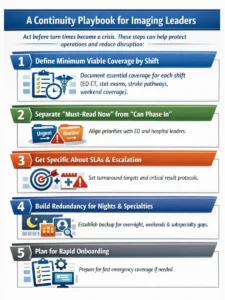
A continuity playbook for imaging leaders infographic with five steps: define minimum viable coverage by shift, separate must-read now from can phase in, set SLAs and escalation, build redundancy for nights/weekends/subspecialty reads, and plan rapid onboarding.

Hospitals are seeing pressure from multiple directions at once: staffing shortages, increasing exam complexity, heavier after-hours demand, and rising expectations for consistent turn times. One indicator the market is under strain: a Neiman Health Policy Institute analysis found that from 2014–2023, the number of practices with affiliated radiologists fell 14.7% while the number of radiologists grew 17.3%, reflecting ongoing consolidation and shifting coverage capacity.” When a group loses even a few radiologists—especially subspecialists—the coverage math can break quickly. Recruiting is rarely immediate, and internal coverage often becomes a patchwork of short-term fixes.


The important takeaway is this: a capacity disruption doesn’t require bad intent to create real clinical and operational risk. That’s why continuity planning matters.


A continuity playbook for imaging leaders

If you suspect your group is approaching a capacity shortfall, the best time to act is before turn times become a crisis. These steps can help protect operations and reduce disruption:

1) Define minimum viable coverage by shift

Document what must be covered on each shift to protect patient flow (e.g., ED CT, inpatient stat, stroke pathways, weekend coverage). This gives you a clear baseline if you need a stopgap plan.


2) Separate “must-read now” from “can phase in”

Not every study needs the same priority level. Align with ED and hospital leadership on what requires immediate final reads vs. what can be scheduled with acceptable delay.

3) Get specific about SLAs and escalation

If turn times are drifting, vague expectations won’t fix it. Define turnaround targets by priority category and document critical-result escalation pathways so the burden doesn’t land on one manager’s phone.

4) Build redundancy for nights, weekends, and subspecialty reads

Capacity collapses often reveal the weakest links first: overnight coverage, weekend staffing, and subspecialty depth. Even if you don’t outsource everything, having a backup partner for the riskiest windows can stabilize operations.

5) Plan for rapid onboarding before you need it

The fastest transitions happen when leadership has already identified what they’d need for an emergency coverage start: modality volumes, hours, PACS/RIS details, dictation preferences, and communication protocols.


How Vesta supports hospitals when coverage is strained or service is disrupted

When a radiology group can’t keep up, hospitals need dependable coverage that restores momentum—not another layer of complexity. Vesta Teleradiology helps facilities stabilize quickly with a continuity-first approach:

  • Scalable capacity to absorb surges and protect turn times
  • Subspecialty interpretation options aligned to case complexity
  • Clear expectations for turnaround and critical results communication
  • Rapid onboarding pathways designed for real hospital workflows

Whether you need temporary stabilization, overflow coverage, nights/weekends support, or a longer-term solution, we can tailor coverage so your imaging team isn’t forced into constant triage mode.


Every staffing disruption has context. The point isn’t to assign blame—it’s to protect continuity of care and keep clinical operations stable. If your facility is seeing warning signs of coverage strain, we can help you assess options and timelines without speculation about any third party.

The Radiologist Shortage in 2026: Coverage Models That Actually Work

By 2026, many imaging leaders have reached the same conclusion: the answer to workforce pressure isn’t simply “hire harder.” Demand remains high, burnout is real, and subspecialty gaps can be difficult (or impossible) to fill quickly.

That’s why the most resilient organizations are redesigning coverage: building models that protect turnaround time, clinical confidence, and staff sustainability.

The shortage isn’t just a feeling—it’s showing up in projections

Recent research and analysis have focused on projecting radiologist supply and imaging demand over the coming decades, highlighting the risk of persistent shortages if current conditions continue. The Neiman Health Policy Institute summarized companion studies published in JACR projecting supply and demand trends through 2055.

The operational translation is simple: if your department plans like staffing will “normalize soon,” you may be planning for a world that doesn’t arrive on schedule.

What breaks first when coverage is thin

When departments run lean, the pain doesn’t spread evenly. It concentrates in predictable places:

  • Nights and weekends (coverage strain + fatigue)
  • ED/inpatient surges (worklist spikes)
  • Subspecialty-demand studies (oncology, neuro, MSK, complex body)
  • Communication friction (more callbacks, more clinician dissatisfaction)

The hospitals that stay stable build models that defend those pressure points first.

Coverage models that work in 2026

Infographic showing four radiology coverage models: core plus overflow, dedicated after-hours, subspecialty on-demand, and hybrid scheduling to reduce burnout and protect turnaround time.

Here are four models that are proving practical in the real world:

1) “Core + overflow” (daytime stability, surge protection)

Your in-house team remains the core, but overflow coverage prevents backlog spirals when volume spikes. This is especially useful during:

  • seasonal peaks
  • staffing gaps (vacations, sick leave)
  • new service line growth

2) Dedicated after-hours coverage (protect your daytime team)

Instead of stretching your day staff into nights, create a defined after-hours plan. The goal is not just coverage—it’s preventing cumulative fatigue that degrades performance over time.

3) Subspecialty on-demand (quality where it matters most)

Rather than trying to hire every subspecialty locally, many hospitals use targeted subspecialty coverage for:

  • oncology staging/follow-up
  • neuro pathways
  • high-impact MSK cases
  • complex body imaging

This reduces risk and increases clinician confidence—without requiring full-time local recruitment for every niche.

4) Hybrid scheduling (reduce burnout and stabilize throughput)

Hybrid models combine:

  • predictable in-house shifts for continuity and relationships
  • external support to protect turnaround time and reduce overtime

These models can also support recruitment—because fewer radiologists want “always-on” schedules in 2026.

How to evaluate whether your model is working

Pick metrics that reflect real operational health:

  • Median and 90th percentile TAT by modality
  • Backlog hours at key times (end of day, weekends)
  • Discrepancy trends / peer review signals
  • Clinician satisfaction or complaint patterns
  • Radiologist overtime hours and call burden

If those metrics are improving, your model is working—even if you still feel “busy.”

Where Vesta fits

Vesta Teleradiology supports hospitals with flexible coverage models—overflow, nights/weekends, and subspecialty interpretation—built to protect turnaround times and clinical confidence without overloading your core team.

If you’re redesigning coverage for 2026, start with your pressure points and build outward. Learn more at https://vestarad.com.