Hospitals need imaging support at all hours, not just during the day. Emergency departments, inpatient units, and urgent care settings all depend on timely radiology interpretation to keep care moving. That is why choosing a 24/7 teleradiology partner is about more than covering overnight shifts. It is about finding a team that can support patient care, reduce delays, and work smoothly within hospital operations.
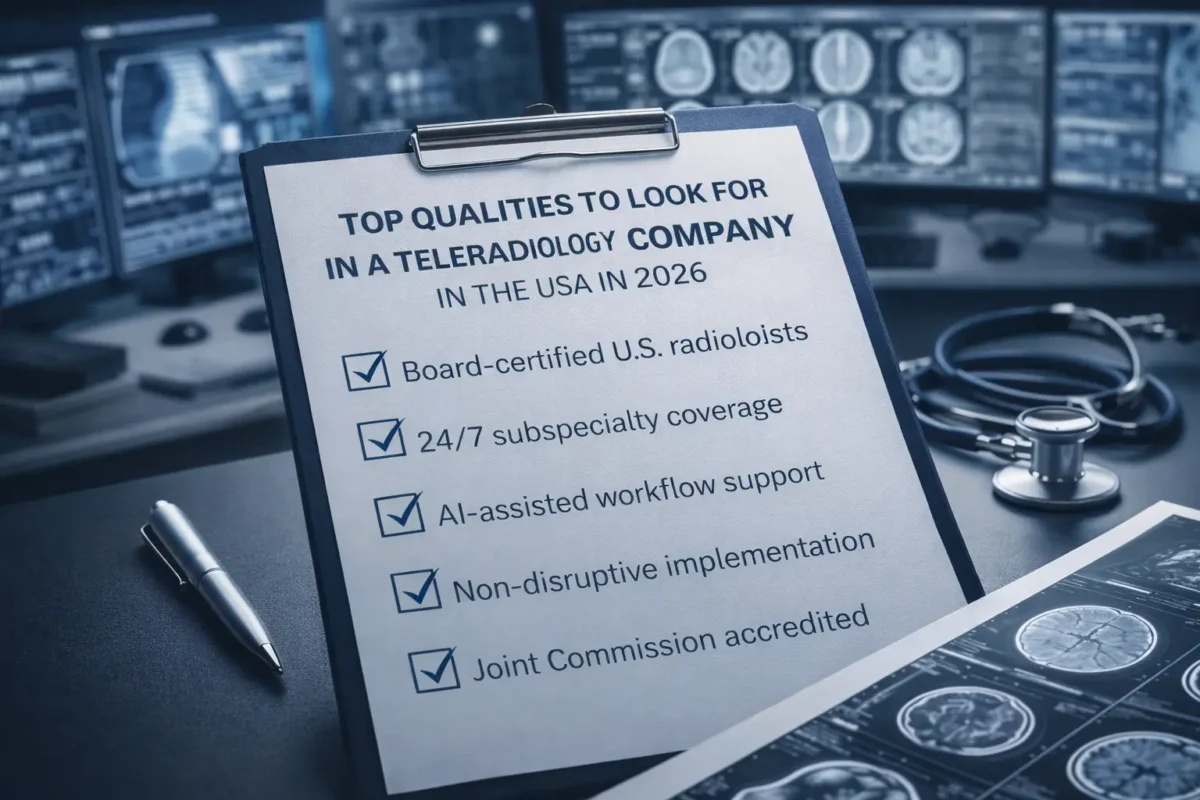
When evaluating providers, hospitals should look for a partner that brings clinical quality, consistent communication, and dependable operational support. The American College of Radiology emphasizes that safe and effective radiology depends on appropriate training, skills, and techniques. The Joint Commission also highlights the value of structured telehealth standards that support quality, consistency, documentation, and credentialing.
Coverage That Matches Real Hospital Needs
A true 24/7 radiology partner should be able to support more than basic overnight reads. Hospitals should ask whether the provider can handle nights, weekends, holidays, daytime overflow, and unexpected spikes in imaging volume. Coverage should feel reliable whether the facility is dealing with a trauma case at 2 a.m. or a busy Sunday of inpatient studies.
It is also important to ask how the provider handles staffing depth. If case volume surges or a radiologist becomes unavailable, the partner should have backup systems in place so service does not suffer.
Qualified Radiologists and Subspecialty Support
One of the most important questions is who is actually reading the studies. Hospitals should look for U.S. board-certified radiologists and ask whether subspecialty support is available when needed. Complex cases may require deeper expertise in areas such as neuroradiology, musculoskeletal imaging, body imaging, or chest imaging.
A provider that offers only general coverage may not be the best fit for every hospital. The right partner should align with the hospital’s patient population, clinical demands, and study mix. Access to subspecialty interpretation can help support greater diagnostic confidence and better care decisions.
Clear Turnaround Expectations
Fast reads matter, but general promises are not enough. Hospitals should ask for clear turnaround expectations for STAT, urgent, and routine studies. A provider should be able to explain what clients can expect during regular overnight coverage, high-volume periods, holidays, and other demanding situations.
Consistency matters just as much as speed. A radiology partner that performs well only under normal conditions may create problems when the workload increases. Hospitals should look for stable service, not just best-case turnaround numbers.
Strong Communication and Reporting
A timely report only helps if important findings reach the care team quickly. Hospitals should ask how critical findings are communicated, who receives the notification, and how that communication is documented.

Reporting quality matters too. The Radiological Society of North America notes that standardized reporting practices can improve efficiency, consistency, and diagnostic quality. For hospitals, that means reports should be clear, actionable, and easy for referring clinicians to use in real time. A good teleradiology partner should support communication workflows that reduce confusion instead of adding extra friction.
Quality Assurance Should Be Part of the Service
Hospitals should never assume quality. They should ask what type of peer review, discrepancy tracking, and internal quality assurance processes the provider uses. A strong radiology partner should have systems in place to monitor performance, review errors, and improve over time.
This matters because hospitals are not simply outsourcing image reads. They are relying on an external team to support clinical decisions. Quality assurance should be built into the service from the beginning.
Credentialing, Compliance, and Workflow Integration
Operational readiness is just as important as clinical support. Hospitals should ask how credentialing is managed, how quickly radiologists can be onboarded, and how the provider supports licensure and compliance requirements. These details become even more important for health systems with multiple facilities or broader geographic coverage.
Technology should also fit into the hospital’s existing workflow. A good partner should work effectively with the facility’s PACS, RIS, and communication systems. The goal is to make the process easier for hospital staff, not more complicated.
A Partner, Not Just a Vendor
The best teleradiology relationships feel collaborative. Hospitals should look for a provider that is responsive, flexible, and prepared to adapt as needs change. That could mean helping during staffing shortages, supporting growth, or providing coverage during periods of unusually high demand.
A strong 24/7 radiology partner should help the hospital deliver timely, consistent care around the clock. When the relationship is built on quality, communication, and operational fit, teleradiology becomes more than after-hours support. It becomes part of a stronger long-term imaging strategy.
Frequently Asked Questions
What is 24/7 teleradiology coverage?
It is continuous radiology interpretation support for hospitals and imaging facilities during nights, weekends, holidays, and other hours when onsite coverage may be limited.
Why do hospitals use teleradiology partners?
Hospitals use teleradiology to maintain timely imaging interpretation, support emergency and inpatient workflows, reduce delays, and expand access to radiology expertise after hours.
What should hospitals ask before signing with a teleradiology provider?
They should ask about radiologist credentials, subspecialty availability, turnaround times, communication protocols for critical findings, quality assurance processes, and credentialing support.
Does subspecialty radiology support matter?
Yes. Some studies benefit from deeper expertise in areas like neuroradiology, musculoskeletal imaging, or body imaging, especially in more complex cases.
Does accreditation matter when choosing a radiology partner?
It can. Accreditation may reflect stronger standards for documentation, credentialing, and operational consistency.
Vesta Teleradiology
Looking for a 24/7 radiology partner that supports your hospital with dependable coverage, fast communication, and subspecialty expertise? Contact Vesta Teleradiology to learn how our team helps facilities strengthen imaging support around the clock.