When Radiology Groups Lose Capacity: How Hospitals Can Protect Coverage, Turnaround Times, and Patient Flow

The quiet risk hospitals don’t plan for: capacity collapse

Radiology coverage doesn’t always fail with a formal termination or an obvious “we’re done” message. More often, it erodes. A radiology group loses key radiologists, experiences unexpected attrition, can’t recruit fast enough, or faces scheduling strain that turns into missed commitments. The hospital still has the same ED demand, the same inpatient needs, and the same responsibility to keep care moving—yet turnaround times slip, subspecialty availability narrows, and internal teams get stretched thin.

From an operational standpoint, the impact can look like an “implosion,” even if the root cause is simply capacity mismatch.


What capacity loss looks like in real hospital workflows

When a radiology group is underwater, the warning signs typically show up as workflow symptoms before anyone names the problem:

  • Growing backlogs during evenings, nights, or weekends
  • Longer final-report turnaround times, especially for CT and MR
  • Reduced subspecialty coverage (neuro, MSK, body, breast)
  • More “wet reads,” delayed overreads, or inconsistent staffing patterns
  • Slower critical result communication and more escalations to leadership
  • Increasing reliance on a small number of radiologists to “save the shift”

None of these are just radiology issues. They affect ED throughput, length of stay, patient satisfaction, and clinician trust.
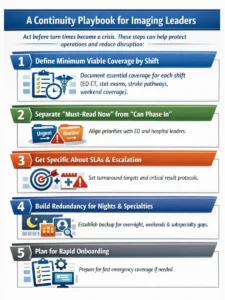
 

A continuity playbook for imaging leaders infographic with five steps: define minimum viable coverage by shift, separate must-read now from can phase in, set SLAs and escalation, build redundancy for nights/weekends/subspecialty reads, and plan rapid onboarding.

Hospitals are seeing pressure from multiple directions at once: staffing shortages, increasing exam complexity, heavier after-hours demand, and rising expectations for consistent turn times. One indicator the market is under strain: a Neiman Health Policy Institute analysis found that from 2014–2023, the number of practices with affiliated radiologists fell 14.7% while the number of radiologists grew 17.3%, reflecting ongoing consolidation and shifting coverage capacity.” When a group loses even a few radiologists—especially subspecialists—the coverage math can break quickly. Recruiting is rarely immediate, and internal coverage often becomes a patchwork of short-term fixes.


The important takeaway is this: a capacity disruption doesn’t require bad intent to create real clinical and operational risk. That’s why continuity planning matters.


A continuity playbook for imaging leaders

If you suspect your group is approaching a capacity shortfall, the best time to act is before turn times become a crisis. These steps can help protect operations and reduce disruption:

1) Define minimum viable coverage by shift

Document what must be covered on each shift to protect patient flow (e.g., ED CT, inpatient stat, stroke pathways, weekend coverage). This gives you a clear baseline if you need a stopgap plan.


2) Separate “must-read now” from “can phase in”

Not every study needs the same priority level. Align with ED and hospital leadership on what requires immediate final reads vs. what can be scheduled with acceptable delay.

3) Get specific about SLAs and escalation

If turn times are drifting, vague expectations won’t fix it. Define turnaround targets by priority category and document critical-result escalation pathways so the burden doesn’t land on one manager’s phone.

4) Build redundancy for nights, weekends, and subspecialty reads

Capacity collapses often reveal the weakest links first: overnight coverage, weekend staffing, and subspecialty depth. Even if you don’t outsource everything, having a backup partner for the riskiest windows can stabilize operations.

5) Plan for rapid onboarding before you need it

The fastest transitions happen when leadership has already identified what they’d need for an emergency coverage start: modality volumes, hours, PACS/RIS details, dictation preferences, and communication protocols.


How Vesta supports hospitals when coverage is strained or service is disrupted

When a radiology group can’t keep up, hospitals need dependable coverage that restores momentum—not another layer of complexity. Vesta Teleradiology helps facilities stabilize quickly with a continuity-first approach:

  • Scalable capacity to absorb surges and protect turn times
  • Subspecialty interpretation options aligned to case complexity
  • Clear expectations for turnaround and critical results communication
  • Rapid onboarding pathways designed for real hospital workflows

Whether you need temporary stabilization, overflow coverage, nights/weekends support, or a longer-term solution, we can tailor coverage so your imaging team isn’t forced into constant triage mode.


Every staffing disruption has context. The point isn’t to assign blame—it’s to protect continuity of care and keep clinical operations stable. If your facility is seeing warning signs of coverage strain, we can help you assess options and timelines without speculation about any third party.

After-Hours Imaging Backlogs: Faster Reads, Shorter ED Length of Stay

Radiology leaders have learned something uncomfortable: even if you have radiologist coverage, you can still have imaging gridlock. The reason is increasingly upstream—technologist staffing and capacity.

A widely cited ASRT survey highlighted a radiologic technologist vacancy rate of 18.1%, up from 6.2% only three years earlier, with real impact on patient scheduling and inpatient length of stay. Source: RSNA overview.


A separate summary for imaging executives echoed the same 18.1% vacancy figure and trend.

The practical takeaway: “radiology staffing” is no longer just a radiologist conversation. Here’s a leader-focused playbook to reduce delays without lowering standards.

How the tech shortage shows up in real metrics

You’ll usually see it in one (or all) of these:

  • Longer time-to-scan (schedule access deteriorates)
  • Higher no-show / reschedule rates (patients can’t find workable slots)
  • More repeats (fatigue + rushing increases error risk)
  • Backlogs that “mysteriously” worsen after holidays, flu surges, or PTO season

A 6-step action plan to reduce delays fast

1) Separate “demand” from “avoidable demand”

Not all imaging volume is equally necessary.

  • Review repeats, protocol errors, and “wrong exam” orders.
  • Tighten ordering pathways with clinicians (standardize indications and exam selection).

Even a small drop in repeat imaging can return capacity.

2) Standardize protocols to reduce tech time per exam

Protocol sprawl increases cognitive load and exam duration.

  • Build a lean “default” protocol set for top 20 exams.
  • Use tech-friendly checklists for complex exams (MRI safety, contrast workflows).
  • Reduce variations across sites in a system.

man operating an MRI machine3) Smooth scheduling around your true capacity

Stop scheduling to an ideal world.

  • Build schedules around realistic staffing (including breaks, transport delays, and room turnover).
  • Protect blocks for ED/inpatient add-ons so outpatient doesn’t implode daily.
  • If you have multiple scanners, assign “quick win” exams to specific rooms to reduce reset time.

4) Use role design to protect your scarce talent

If your MRI tech is doing tasks that don’t require MRI training, you lose throughput.

  • Shift non-licensed tasks away from techs where possible (transport coordination, documentation steps, room prep).
  • Cross-train strategically (don’t cross-train everyone on everything—target the biggest bottlenecks).

5) Measure the right bottleneck metrics

Leaders often track report turnaround time but miss the upstream constraint.
Add:

  • order-to-scan time
  • scan-to-dictation start time
  • exams per tech hour
  • repeat rate (by modality and shift)

6) Backstop interpretation capacity so tech gains don’t get wasted

When tech workflows improve, volume rises—and the next bottleneck becomes reading capacity.


This is where flexible interpretation support helps protect throughput:

  • prevent end-of-day reading pileups
  • keep ED reads moving after-hours
  • maintain consistency when staffing fluctuates

7) Make backlog reduction a burnout intervention

Overnight backlog doesn’t only harm metrics—it burns people out. A calmer, more predictable workflow improves clinician experience and decreases error risk.


Where Vesta fits


Vesta Teleradiology supports hospitals and imaging programs that want to keep overnight and weekend imaging moving—with dependable coverage and consistent interpretation quality. The goal is simple: fewer backlogs, steadier turnaround times, and smoother ED throughput.


CY 2026 Physician Fee Schedule: What Imaging Leaders Should Watch (and Why “Average” Doesn’t Apply)

Every year, the Medicare Physician Fee Schedule (PFS) creates ripple effects across imaging—often in ways that don’t show up in headlines. In late 2025, CMS released the CY 2026 PFS final rule, effective January 1, 2026. 

Here’s the most important operational truth for radiology leaders in 2026:

The revenue impact isn’t uniform—so “average change” isn’t actionable

Even if the overall conversion factor movement looks modest, imaging departments don’t bill an “average” service. You bill your mix of modalities, your setting, your patient population, and your staffing model.

That’s why the right response to the 2026 PFS is not a quick budget adjustment—it’s a targeted modeling exercise.

What to model first (a simple sequence that works)

Instead of trying to interpret every line of the rule at once, start by modeling what can materially impact decisions:

1) Modality mix

Break your radiology work into buckets that align with how your service lines actually function:

  • CT
  • MR
  • X-ray
  • Ultrasound
  • Nuclear Medicine / PET
  • Interventional (if applicable)

Then estimate the revenue shift by bucket based on your billed codes and volumes.

2) Code mix inside each modality

Within CT or MR, the mix matters:

  • ED-heavy vs outpatient-heavy patterns
  • Trauma and stroke volumes vs routine follow-ups
  • High-complexity oncology imaging vs general imaging

Small per-code shifts can become meaningful if a code represents a high-volume pathway.

3) Setting and coverage realities

Your operational plan should reflect how studies arrive and when they must be read:

  • ED surges
  • Nights/weekends
  • Seasonal peaks
  • Staff vacation coverage

If you model reimbursement without modeling coverage demands, you risk cutting resources that protect throughput and clinician satisfaction.

Why the conversion factor is only the starting point

The PFS conversion factor tends to get the most attention, but radiology leaders often feel the downstream effects through:

  • Service line prioritization (what gets resourced vs delayed)
  • Pressure to improve productivity and reduce “avoidable” repeats
  • Coverage decisions (especially after-hours)
  • Subspecialty availability (which can impact quality and clinician confidence)

Professional societies also track conversion-factor details and implementation considerations for specialties impacted by the rule. 

A practical 2026 strategy: protect throughput, not just budget

A department that protects patient flow and ED throughput often becomes more valuable—even in tight reimbursement environments. Three operational levers tend to produce outsized returns:

1) Standardize protocols where possible

Reducing variation can lower repeat imaging and improve consistency.

2) Reduce time-to-read friction

Worklist management, routing, and coverage planning can take pressure off your core team.

3) Ensure subspecialty access when it matters

Oncology, neuro, MSK, and complex body imaging are often the studies that drive high clinical impact—and the highest risk when resources are stretched.

Where Vesta helps

If your 2026 modeling shows that coverage needs to be more flexible—without compromising quality—Vesta Teleradiology can help you stabilize operations with scalable subspecialty interpretation for overflow, after-hours, or targeted service lines.

If you want to pressure-test your coverage model against your real modality and code mix, visit https://vestarad.com.

The Radiologist Shortage in 2026: Coverage Models That Actually Work

By 2026, many imaging leaders have reached the same conclusion: the answer to workforce pressure isn’t simply “hire harder.” Demand remains high, burnout is real, and subspecialty gaps can be difficult (or impossible) to fill quickly.

That’s why the most resilient organizations are redesigning coverage: building models that protect turnaround time, clinical confidence, and staff sustainability.

The shortage isn’t just a feeling—it’s showing up in projections

Recent research and analysis have focused on projecting radiologist supply and imaging demand over the coming decades, highlighting the risk of persistent shortages if current conditions continue. The Neiman Health Policy Institute summarized companion studies published in JACR projecting supply and demand trends through 2055.

The operational translation is simple: if your department plans like staffing will “normalize soon,” you may be planning for a world that doesn’t arrive on schedule.

What breaks first when coverage is thin

When departments run lean, the pain doesn’t spread evenly. It concentrates in predictable places:

  • Nights and weekends (coverage strain + fatigue)
  • ED/inpatient surges (worklist spikes)
  • Subspecialty-demand studies (oncology, neuro, MSK, complex body)
  • Communication friction (more callbacks, more clinician dissatisfaction)

The hospitals that stay stable build models that defend those pressure points first.

Coverage models that work in 2026

Infographic showing four radiology coverage models: core plus overflow, dedicated after-hours, subspecialty on-demand, and hybrid scheduling to reduce burnout and protect turnaround time.

Here are four models that are proving practical in the real world:

1) “Core + overflow” (daytime stability, surge protection)

Your in-house team remains the core, but overflow coverage prevents backlog spirals when volume spikes. This is especially useful during:

  • seasonal peaks
  • staffing gaps (vacations, sick leave)
  • new service line growth

2) Dedicated after-hours coverage (protect your daytime team)

Instead of stretching your day staff into nights, create a defined after-hours plan. The goal is not just coverage—it’s preventing cumulative fatigue that degrades performance over time.

3) Subspecialty on-demand (quality where it matters most)

Rather than trying to hire every subspecialty locally, many hospitals use targeted subspecialty coverage for:

  • oncology staging/follow-up
  • neuro pathways
  • high-impact MSK cases
  • complex body imaging

This reduces risk and increases clinician confidence—without requiring full-time local recruitment for every niche.

4) Hybrid scheduling (reduce burnout and stabilize throughput)

Hybrid models combine:

  • predictable in-house shifts for continuity and relationships
  • external support to protect turnaround time and reduce overtime

These models can also support recruitment—because fewer radiologists want “always-on” schedules in 2026.

How to evaluate whether your model is working

Pick metrics that reflect real operational health:

  • Median and 90th percentile TAT by modality
  • Backlog hours at key times (end of day, weekends)
  • Discrepancy trends / peer review signals
  • Clinician satisfaction or complaint patterns
  • Radiologist overtime hours and call burden

If those metrics are improving, your model is working—even if you still feel “busy.”

Where Vesta fits

Vesta Teleradiology supports hospitals with flexible coverage models—overflow, nights/weekends, and subspecialty interpretation—built to protect turnaround times and clinical confidence without overloading your core team.

If you’re redesigning coverage for 2026, start with your pressure points and build outward. Learn more at https://vestarad.com.

Vesta Teleradiology Heads to RSNA 2025: AI + Expertise = Faster, Smarter Imaging Coverage


Every year, the Radiological Society of North America (RSNA) brings together innovators shaping the future of medical imaging. This November 30–December 3, 2025, the Vesta Teleradiology team is proud to join that community at RSNA 2025 in Chicago — showcasing how AI and human expertise combine to deliver faster, smarter imaging coverage for hospitals and imaging centers nationwide.

Meet Vesta at Booth 1346 — South Hall

At Booth 1346, attendees can discover how Vesta helps healthcare facilities overcome some of today’s biggest radiology challenges — from staffing shortages to increasing imaging volumes — without compromising patient care.

Vesta’s solutions are designed to help your organization:

  • Gain 24/7 radiology coverage without the burnout
  • Access fellowship-trained subspecialists across all modalities
  • Deliver faster turnaround times with AI-assisted workflow tools
  • Scale imaging services without adding staff
  • Rely on dependable IT services and seamless PACS integration

How Vesta Combines AI + Human Expertise

Teleradiology isn’t just about remote reads — it’s about precision, speed, and collaboration. Vesta’s radiologists use advanced AI-assisted workflow technology to prioritize cases, enhance diagnostic consistency, and streamline communication with hospitals and imaging centers.

AI tools don’t replace radiologists; they empower them. By automating repetitive tasks and highlighting critical findings faster, AI allows Vesta’s board-certified radiologists to focus where their expertise matters most — delivering accurate interpretations and improving patient outcomes around the clock.

Dependable Excellence, Every Time

Since its founding, Vesta has remained committed to providing dependable, high-quality radiology coverage that healthcare organizations can trust. Whether you need overnight support, overflow assistance, or full departmental coverage, Vesta’s network of U.S.-based, fellowship-trained subspecialists ensures that every scan gets the attention it deserves — anytime, anywhere.

Join Us in Chicago

If you’re attending RSNA 2025, we’d love to meet you in person. Stop by Booth 1346 in the South Hall to see how Vesta’s combination of human insight and artificial intelligence is helping healthcare facilities achieve diagnostic excellence — without adding to their workload.

RSNA 2025 — Chicago, IL
November 30 – December 3, 2025
VESTARAD.COM

What CMS1074v2 Means for CT Radiation Dose Monitoring and Radiology Workflows

June 2025: CMS Rolls Out New CT Dose Quality Measure

In June 2025, the Centers for Medicare & Medicaid Services (CMS) officially implemented a new CT quality measure: CMS1074v2, which focuses on radiation dose and image quality metrics. The rule affects all healthcare providers performing computed tomography (CT) exams and is designed to enhance patient safety while addressing inconsistencies in dose reporting across facilities.

This marks a notable evolution in how CT imaging quality is tracked and reported under CMS’s Quality Payment Program, reinforcing the agency’s continued emphasis on value-based care and precision in diagnostic imaging.

What Is CMS1074v2?

CMS1074v2 centers around the calculation and monitoring of Size-Adjusted Dose (SAD) during CT scans. The measure requires providers to calculate a size-adjusted dose for each CT exam using effective diameter, then evaluate those values against accepted benchmarks for different anatomical regions (thorax, abdomen, pelvis, etc.).

This measure doesn’t just focus on radiation exposure — it links dose appropriateness with image quality, requiring radiology teams to balance diagnostic clarity and patient safety.

According to CMS, the goal is to encourage facilities to reduce unnecessary radiation while ensuring CT scans still meet clinical utility standards .

Why Is This a Big Deal for Radiology?

The challenge in radiology has long been striking a balance between diagnostic quality and dose minimization. Prior to CMS1074v2, there was no universal requirement for how facilities calculated size-adjusted dose, leading to large variability in methods and outcomes.

A March 2025 study published on arXiv found that five widely used methods for estimating effective diameter yielded significant differences in SAD calculations, which could directly influence whether a CT scan was categorized as compliant or not (source).

CMS1074v2 aims to reduce that variability by enforcing a consistent approach across providers. While the measure is currently limited to CT scans performed in outpatient settings, it’s expected that similar benchmarks may be expanded into hospital settings in the future.

How Imaging Centers Can Prepare

Implementing CMS1074v2 isn’t just about adding a new line item to reporting tools — it may require substantial changes to imaging workflows, technology, and staff training.

Here are key steps radiology departments should take:

  • Standardize Effective Diameter Calculations: Ensure your PACS or scanner software uses consistent measurement protocols.
  • Review CT Protocols for Dose Optimization: CT protocols may need to be adjusted to meet benchmark thresholds without compromising image quality.
  • Invest in Staff Training: Radiology technologists and supervising physicians must understand how SAD is derived and what values are considered acceptable for each body region.
  • Audit Current Practices: Review your historical CT exams to identify whether your dose metrics currently fall within expected parameters.

Potential Impact on Reimbursement and Compliance

CMS1074v2 is part of the Merit-Based Incentive Payment System (MIPS), which affects how radiology providers are scored for quality performance. Noncompliance or poor performance on this measure could reduce reimbursement — especially for those participating in the Quality Payment Program.

However, facilities that demonstrate high compliance may benefit from positive scoring adjustments and recognition for imaging excellence. In other words, meeting this benchmark isn’t just about avoiding penalties — it could position your imaging center as a high-quality provider under CMS metrics.

Bottom Line: A Push Toward Precision and Safety

CMS1074v2 represents a bigger shift in imaging: toward measurable safety, transparency, and data-driven quality assurance. For radiology providers, especially those involved in high-volume CT scanning, this rule presents an opportunity to fine-tune protocols, improve patient outcomes, and strengthen compliance in a competitive healthcare environment.

While implementation requires coordination across teams, IT systems, and scanners, the end result may be safer, more efficient imaging that aligns with the future of value-based care.


Mid-Year Radiology Trends: What’s Shaping Diagnostic Imaging in 2025

The pace of change in radiology and diagnostic imaging only accelerated in 2025. From emerging technologies to new ways of working, the field is evolving rapidly to meet both growing patient demand and the ongoing challenge of radiologist shortages.

Here’s a look at the key mid-year trends shaping radiology so far this year—and how facilities can stay ahead with the right partners.


  1. AI Is Evolving—But Radiologists Remain at the Center

AI tools in radiology are becoming more sophisticated, particularly in automating administrative tasks like report generation, triage, and workflow optimization.

A recent article from Business Insider noted that many radiologists now use generative AI to streamline productivity—not replace their diagnostic expertise. The key is finding the right balance: AI assists, but human interpretation remains critical.

At Vesta Teleradiology, our board-certified radiologists embrace AI tools that improve speed and accuracy while maintaining clinical oversight and patient safety.


  1. Staffing Pressures Continue—and Teleradiology Bridges the Gap

Radiologist shortages are still a frontline issue in 2025. The Neiman Health Policy Institute projects the shortage will persist through 2055 without proactive changes. This strain is particularly acute in oncology and rural hospitals, where delays in imaging results can directly impact outcomes.

Teleradiology is now an essential solution for many facilities. At Vesta, we provide:
✅ 24/7/365 STAT & routine reads
✅ Subspecialty support (Neuro, MSK, Cardiac, Pediatrics, and more)
✅ No minimum read requirements
✅ Customizable workflows to fit your needs


  1. Photon-Counting CT: A Game-Changer for Imaging

Photon-counting CT (PCCT) is gaining traction in 2025, offering higher resolution images with lower radiation doses. Early adopters are seeing promising results in cardiovascular and oncologic imaging.

As new modalities enter clinical use, having expert radiologists trained in advanced imaging techniques is vital. Vesta’s subspecialty readers are ready to interpret the most complex cases with precision.

  1. The Rise of Digital Twins in Imaging

Digital twins—virtual models of patients—are becoming more practical in healthcare. Radiology plays a key role by providing the high-fidelity imaging needed to create these models for personalized medicine, treatment planning, and disease monitoring.

As these technologies develop, facilities will need radiologists with the expertise to interpret increasingly complex imaging data—and flexible partners to help scale their capabilities.


  1. Growing Focus on Turnaround Times and Patient Experience

With patients and referring physicians expecting faster results, facilities are under pressure to reduce turnaround times—especially for oncology, trauma, and screening programs.

Vesta Teleradiology helps meet this demand with:

  • 24/7 availability to prevent backlogs
  • Real-time communication for critical findings
  • Customizable reporting to fit your workflow and brand


Conclusion: How to Stay Ahead in a Fast-Moving Year

The radiology landscape is dynamic—and staying ahead requires agility, expertise, and trusted partners. Whether you’re looking to bridge staffing gaps, scale subspecialty reads, or handle advanced imaging modalities, Vesta Teleradiology is here to help.

Our U.S.-based, board-certified radiologists deliver precision reads with flexible, scalable solutions for hospitals, imaging centers, and healthcare systems nationwide.

Let’s connect today to customize a radiology solution that fits your 2025 needs—and beyond.

Contact Vesta Teleradiology.


Sources:

Business Insider
arXiv.org 
arXiv.org 
The Imaging Wire 

The Silent Strain: How Radiologist Shortages Are Impacting Patient Wait Times Nationwide

Across the United States, radiologist shortages are creating a ripple effect that many patients never see—until they’re left waiting. Waiting for a diagnosis. Waiting for peace of mind. Waiting for answers that may change the course of their care.

In Michigan, a patient recently reported waiting over 80 days for imaging results. Another waited three months for mammogram findings. These delays aren’t isolated. They’re part of a larger trend, driven by a persistent imbalance between the number of radiologists available and the ever-growing demand for diagnostic imaging.

A Nationwide Bottleneck

According to recent projections from the Harvey L. Neiman Health Policy Institute, the radiologist shortage is expected to continue through 2055 if action isn’t taken. Even with moderate increases in the number of new residents entering the field, demand for imaging — especially advanced modalities like CT and MRI — is expected to outpace supply.

Contributing factors include:

  • An aging population requiring more imaging.
  • Increasing use of imaging in preventive and chronic disease care.
  • Radiologist burnout and early retirements, especially post-COVID.
  • Limited growth in federally funded residency slots.

The Real-World Impact: Delayed Diagnoses, Frustrated Patients

For hospitals and imaging centers, the shortage translates into longer turnaround times, heavier workloads, and sometimes critical delays. For patients, the effects are personal and painful.

Delayed imaging results can:

  • Prolong anxiety around undiagnosed conditions.
  • Delay the start of necessary treatment.
  • Create bottlenecks in care coordination between departments.

And for rural or smaller hospitals, the challenge is even greater. With fewer in-house specialists, these facilities are often forced to outsource or delay imaging interpretations—unless they have a trusted teleradiology partner.

A Scalable Solution: Vesta Teleradiology

At Vesta Teleradiology, we understand the strain radiology departments are under. That’s why we offer 24/7/365 access to U.S.-based, board-certified radiologists—available for both preliminary and final reads, STAT or routine. Whether you’re managing a busy urban hospital or a small rural facility, our scalable services can be tailored to your needs.

We provide:

  • No minimum read requirements
  • Subspecialty interpretations across neuro, MSK, cardiac, PET, pediatric, and more
  • Customizable workflows and reporting formats
  • Efficient communication channels for urgent findings and consults

Our goal is simple: to help you deliver timely, high-quality care without compromise.

The Bottom Line

Radiologist shortages may be a long-term challenge, but patient care can’t wait. Hospitals and healthcare facilities need dependable partners now more than ever.

If your team is feeling the pressure of delayed reads or overwhelmed radiology staff, Vesta Teleradiology is here to help.

Reach out today to learn how we can support your imaging department with fast, flexible, and expert radiology interpretations.


Navigating 2025 Medicare Reimbursement Changes: What Healthcare Providers Need to Know About CCTA and Imaging Services

The 2025 Medicare reimbursement updates bring significant changes for healthcare providers, particularly in coronary computed tomography angiography (CCTA) and other imaging services. While CCTA reimbursement rates have increased, the overall Medicare Physician Fee Schedule (MPFS) faces a 2.83% reduction in the conversion factor, impacting reimbursement for many radiology procedures (CMS, 2025 MPFS Final Rule).

Healthcare providers must navigate these reimbursement shifts carefully to maintain financial stability while continuing to offer high-quality imaging services.


CCTA Reimbursement Increases: What It Means for Healthcare Providers

One of the most notable changes in 2025 is the increased reimbursement for CCTA procedures. CMS has reclassified key CCTA billing codes (CPT 75572, 75573, and 75574) into a higher Ambulatory Payment Classification (APC 5572), effectively doubling the payment rate from $175.06 in 2024 to $357.13 in 2025 (Society of Cardiovascular Computed Tomography, 2024).

This increase recognizes the growing importance of CCTA in diagnosing coronary artery disease and aligns reimbursement with the true cost of performing these procedures (American College of Radiology, 2024).

Why This Matters for Imaging Centers & Hospitals

  • Higher reimbursement rates make it more feasible for facilities to invest in CCTA technology and training.
  • More healthcare facilities may begin offering CCTA, increasing early detection and diagnosis of cardiovascular condition. (auntminnie.com)
  • Billing teams must adjust their coding practices to ensure proper reimbursement under the new APC classification.
  • Increased demand for CCTA interpretations means imaging centers may need additional subspecialized radiologists to handle workflow efficiently.


The 2.83% Reduction in Medicare Physician Fee Schedule (MPFS) & Its Impact on Imaging Services

Despite higher CCTA reimbursement, the 2025 MPFS introduces an overall 2.83% reduction in the conversion factor, lowering it from $33.2875 per Relative Value Unit (RVU) in 2024 to $32.3465 per RVU in 2025. (tctmd.com)

Key Impacts on Imaging Facilities

  • Many high-volume imaging procedures will see reduced Medicare payments, including mammography and ultrasound.
  • Global reimbursement rates remain stagnant or have been cut for many procedures
  • Providers must evaluate their imaging service mix to determine how reimbursement cuts will affect their bottom line (American College of Radiology, 2024).
  • Workforce costs remain a concern, as imaging centers must balance reimbursement fluctuations with staffing needs.

How Teleradiology Can Help Healthcare Facilities Adapt to Reimbursement Challenges

As imaging centers and hospitals adjust to the 2025 Medicare changes, outsourcing radiology interpretations through a trusted teleradiology provider like Vesta Teleradiology can help offset financial pressures while maintaining high-quality imaging services.

Key Benefits of Teleradiology in the 2025 Reimbursement Landscape

Reduce on-site radiology costs

    • Instead of hiring full-time, in-house radiologists for subspecialties like cardiac CT or breast imaging, facilities can outsource interpretations to Vesta’s U.S.-trained, board-certified radiologists
    • This allows hospitals and imaging centers to scale their services without the overhead of additional full-time staff.

Ensure subspecialty coverage without staffing challenges

      • The increased demand for CCTA interpretations due to higher reimbursement rates means that having access to experienced cardiovascular radiologists is essential.
      • Vesta provides access to subspecialized radiologists in cardiology, musculoskeletal imaging, neuroradiology, and more. 

Improve turnaround times without hiring additional radiologists

    • With lower reimbursements and tight budgets, imaging centers must optimize workflow efficiency.
    • Vesta’s 24/7 coverage ensures rapid turnaround times for both STAT and routine reads, allowing facilities to handle increased CCTA volume efficiently (Radiology Business, 2024). 

Scalable radiology solutions for uncertain reimbursement environments

    • Since Medicare rates fluctuate, hospitals and imaging centers need flexibility in their radiology staffing models.
    • Teleradiology allows facilities to scale services up or down based on reimbursement trends, patient volume, and staffing needs (American College of Radiology, 2024).


Preparing for the 2025 Medicare Reimbursement Landscape

Reimbursement for radiology services is evolving, with higher CCTA payments but an overall MPFS reduction affecting many imaging services.

Hospitals, imaging centers, and outpatient facilities must reassess their radiology staffing and billing practices to stay financially stable.

Teleradiology provides a cost-effective solution to help healthcare facilities manage these changes, optimize workflow, and maintain high-quality imaging services.

With Vesta Teleradiology’s flexible radiology solutions, healthcare providers can navigate reimbursement challenges while ensuring excellent patient care.

Want to discuss how Vesta Teleradiology can support your facility through these reimbursement changes? Contact us today!


Finding the Right Teleradiology Company: Why Subspecialty Expertise Matters More Than Ever

As the demand for specialized medical imaging continues to rise, healthcare facilities face significant challenges in accessing qualified radiologists, particularly in subspecialties such as neuroradiology, musculoskeletal radiology, and pediatric imaging. This shortage is exacerbated in rural hospitals and underserved areas, where recruiting and retaining subspecialty radiologists is often difficult. Partnering with a teleradiology company that offers subspecialty expertise has become essential for ensuring timely and accurate diagnoses.​

The Growing Demand for Subspecialty Teleradiology

Several factors contribute to the increasing need for subspecialty teleradiology services:​

  • Aging Population: The U.S. population aged 65 and older grew by 38.6% from 2010 to 2020, leading to a higher demand for imaging services. ​acr.org
  • Radiologist Workforce Shortage: Approximately 56.4% of diagnostic radiologists are 55 or older, indicating a significant portion of the workforce is nearing retirement. ​medicushcs.com
  • Increased Imaging Utilization: Advancements in medical imaging technology have led to more frequent use of imaging studies, increasing the workload for radiologists. ​acr.org

These trends underscore the necessity for teleradiology services that provide access to subspecialty-trained radiologists, ensuring that healthcare providers can meet the growing demands of patient care.​

Supporting Rural Hospitals and Underserved Areas

Rural hospitals often face unique challenges in providing comprehensive radiology services due to limited access to subspecialty radiologists. Teleradiology bridges this gap by enabling remote interpretation of imaging studies, allowing rural healthcare providers to offer quality healthcare services locally and at lower costs. ​ruralhealthinfo.org

rural radiologistsHow Vesta Teleradiology Provides Specialized Radiology Support

Vesta Teleradiology addresses these challenges by offering comprehensive teleradiology services nationwide, including:​

  • Access to Subspecialty-Trained Radiologists: Vesta provides access to a wide range of highly specialized, U.S.-trained, and American Board of Radiology-certified radiologists proficient in various modalities.​ 
  • Customizable Reporting and PACS Solutions: Our reporting module allows customization of reports to include the facility’s logo and adjust layouts to match existing reports. Our comprehensive PACS enables the creation of master accounts with sub-accounts, facilitating seamless integration into existing workflows.​ 
  • 24/7 STAT and Routine Reads: We interpret both STAT and routine cases, delivering detailed interpretations with quick turnaround times (Ohio, Illinois, Arizona, Georgia, Florida and more). Our flexible workflow supports various facility needs, from portable imaging units to stand-alone imaging centers and hospitals handling high-end cases.​ 
  • Efficient Communication with Referring Physicians: Our case managers facilitate communication between our radiologists and the facility’s referring physicians to answer questions and relay positive findings promptly. We customize the notification of significant findings to different recipients based on the time of day.​
Why Subspecialty Teleradiology Matters for Patient Care

Utilizing subspecialty-trained radiologists through teleradiology services like Vesta ensures:​

  • Accurate Diagnoses: Specialized radiologists are adept at identifying subtle findings specific to their area of expertise, leading to precise diagnoses.​ 
  • Timely Treatment: Quick access to expert interpretations facilitates prompt decision-making and initiation of appropriate treatments.​ 
  • Cost Efficiency: Accurate and timely diagnoses can reduce unnecessary tests and procedures, optimizing healthcare resources.​
The Right Teleradiology Partner Makes All the Difference

Choosing a teleradiology provider with subspecialty expertise is crucial for delivering high-quality patient care. Vesta Teleradiology offers:​

  • U.S.-trained, board-certified subspecialists
  • Fast, detailed interpretations with high accuracy
  • Seamless PACS and reporting system integration
  • Dedicated support and case management
  • Reliable coverage for rural and critical access hospitals

By partnering with Vesta Teleradiology, healthcare facilities can enhance their diagnostic capabilities, improve patient outcomes, and efficiently manage increasing imaging demands.