2025 Year-End Review: The Radiology & Diagnostic Imaging Headlines That Mattered

Key Takeaways

AI shifted from pilot projects to real workflow infrastructure—with more focus on governance, validation, and safety in daily operations.

Photon-counting CT moved closer to mainstream adoption, strengthening the business case for next-gen CT planning and protocol upgrades.

Reimbursement and policy pressure stayed intense, keeping budgeting, contracting, and service-line ROI under a microscope.

Prior authorization and imaging appropriateness remained major throughput challenges, impacting scheduling, patient access, and operational efficiency.

Cybersecurity and downtime readiness became core imaging priorities, as ransomware and system disruptions increasingly threaten continuity of interpretation.

Radiology didn’t have a single “one story” year—it had a “many small shifts became operational reality” year. In 2025, diagnostic imaging leaders saw AI move from pilots into production workflows, next-gen CT mature from promise to procurement conversations, reimbursement pressures intensify, and cybersecurity become inseparable from patient care. Meanwhile, staffing strain and consolidation continued to reshape how coverage is delivered.

Below is a practical wrap-up of the biggest breakout themes from 2025—and what they signal for 2026 planning.

1) AI moved from point solutions to regulated, workflow-embedded infrastructure

If 2023–2024 was the era of “AI can detect X,” 2025 was the era of “AI has to behave safely inside real clinical systems.” Regulatory claritya and operational expectations became the story as much as the algorithms themselves. RSNA’s coverage highlighted how the FDA has been articulating pathways and challenges for AI-enabled radiology devices—making governance, validation, monitoring, and safety considerations a board-level topic, not just an R&D conversation. Daily Bulletin

At the same time, 2025’s conversation broadened from task-specific tools to foundation models and multimodal systems (images + text) that could impact triage, reporting support, and quality workflows—while also raising new risks around bias, generalizability, and clinical readiness. DirJournal

Operational takeaway for imaging leaders: AI value in 2025 increasingly depended on integration (PACS/RIS/reporting), change management, and clear accountability—especially as adoption expands and expectations shift from novelty to measurable outcomes. The Washington Post

2) Photon-counting CT stepped into the “real adoption” phase

Photon-counting CT (PCCT) wasn’t framed as a future curiosity this year—it showed up as a maturing platform with expanding clinical evidence and increasing operational readiness. RSNA 2025 coverage specifically called out how PCCT is taking center stage as the next CT evolution. Applied Radiology
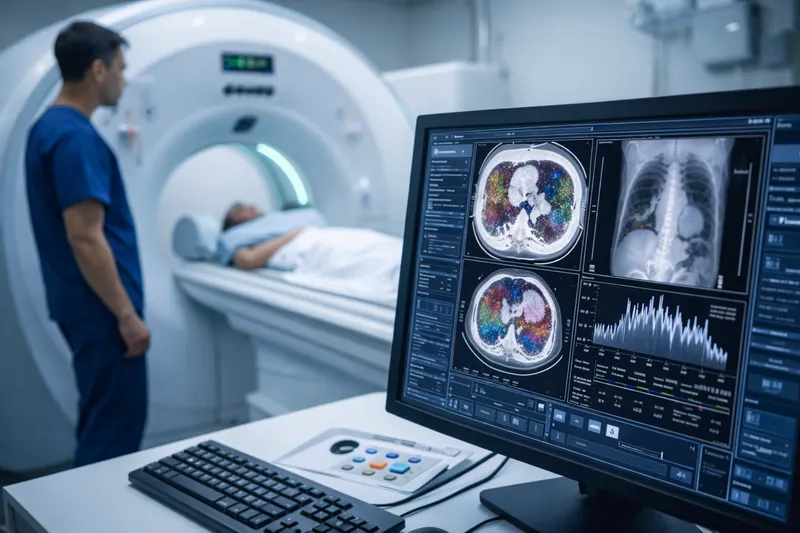
CT scan in progress with technologist beside scanner and diagnostic imaging workstation displaying CT and chest x-ray resultsAcross 2025 literature and trade coverage, the narrative tightened around what administrators care about: clearer visualization and characterization, potential dose efficiencies, and broader specialty applications as the evidence base grows. ScienceDirect

Operational takeaway: If you’re building 3–5 year replacement plans, 2025 made PCCT a serious line item conversation—especially for high-volume sites where incremental image quality and protocol optimization can compound into throughput, repeat-scan reduction, and clinician confidence.

3) Payment pressure stayed relentless—and policy debates sharpened

For many departments, 2025 felt like a year of doing more with less. The 2025 Medicare Physician Fee Schedule (MPFS) final rule remained a major planning input for imaging groups and hospital finance teams, with ACR publishing a detailed imaging-focused summary of provisions and QPP updates. American College of Radiology

At the end of the year, broader Medicare payment policy debates also made headlines—reinforcing that specialty payment and “efficiency” assumptions are likely to stay politically active topics heading into 2026. Axios

Operational takeaway: Contracting, service line budgeting, and modality ROI assumptions increasingly need “policy sensitivity” built in—especially for outpatient imaging strategy and subspecialty coverage models.

4) Utilization management: prior auth and “right test, right patient” stayed in focus

Utilization controls continued to evolve. CMS prior authorization programs for certain outpatient services remain part of the broader backdrop of controlling unnecessary volume. CMS And late-2025 headlines underscored expanding demonstrations tied to prior authorization in additional settings, which imaging leaders often experience downstream as scheduling friction, referral leakage, or delayed care. Kiplinger

On the imaging appropriateness front, the Medicare AUC program remains a major framework (even as implementation timelines and mechanisms continue to be debated). CMS In 2025, ACR also publicly backed federal legislation (the ROOT Act) positioned as a way to revitalize Medicare imaging appropriateness workflows. American College of Radiology

Operational takeaway: Expect “appropriateness” and “utilization proof” to keep rising as operational requirements—meaning your radiology operation will benefit from tighter ordering communication loops, smarter triage, and documentation hygiene.

5) Breast imaging compliance stayed operationally important—density language included

Breast density notification requirements became routine compliance work after enforcement of MQSA’s amended regulations began in 2024, and 2025 was about living with the operational realities: consistent report language, patient communication workflows, and inspection readiness. U.S. Food and Drug Administration

Notably, 2025 also saw attention on density reporting language options under MQSA—an example of how “small wording changes” can have major downstream effects in templates, patient letters, and audit processes. DenseBreast-info, Inc.

Operational takeaway: Standardization wins here—clear templates, audit trails, and staff training reduce risk while improving patient communication consistency.

6) Workforce strain and burnout remained the constant—and coverage models kept shifting

Radiology’s capacity crunch persisted in 2025. ACR continued to flag ongoing workforce shortages amid rising imaging demand, while national physician burnout tracking suggested improvement from prior peaks but still elevated rates that affect retention and coverage reliability.

Operational takeaway: The “coverage plan” is now a strategic asset. Departments that treat coverage as a system (subspecialty access, peak-demand flex, nights/weekends/holidays, overflow protection, and consistent turnaround governance) are better positioned for 2026.

7) Cybersecurity became inseparable from imaging operations

Cyber risk is no longer “IT’s problem”—it’s a continuity-of-care risk, especially for imaging organizations that depend on always-on networks and data flow. In 2025, radiology-specific alerts and incidents reinforced how real the threat landscape is, from FBI-linked warnings about ransomware targeting healthcare entities to major breach reporting involving large imaging providers. Radiology Business

cyber security risksOperational takeaway: Imaging leaders should be asking: Do we have downtime playbooks? How resilient is PACS access? How are third-party integrations governed? How do we preserve interpretation continuity if local systems are disrupted?

A 2026-ready checklist for imaging leaders

Here’s what 2025’s headlines suggest you prioritize next:

  • AI governance that’s operational, not theoretical: validation, monitoring, and workflow accountability.
  • Modern CT strategy: map where photon-counting CT could change protocols, dose strategy, and long-term equipment planning. Applied Radiology
  • Payment + policy resilience: bake MPFS sensitivity into budgets and service line forecasts.
  • Utilization friction planning: anticipate prior-auth expansion impacts on scheduling and throughput.
  • Compliance consistency in breast imaging: templates, audits, and MQSA-ready workflows.
  • Coverage strategy as a system: subspecialty access + surge/overflow + nights/weekends/holidays planning.
  • Cyber continuity: imaging downtime workflows and vendor access governance.

Where Vesta Teleradiology fits in a “do more with less” reality

For hospitals and imaging centers, one of the most immediate ways to de-risk 2026 is to strengthen coverage—especially when staffing shortages collide with growing imaging demand. Vesta Teleradiology supports facilities with 24/7/365 coverage (including nights, weekends, and holidays) and subspecialty radiology interpretations designed to integrate with your existing technology and workflows.

If you’re planning for 2026 coverage resilience—overflow protection, consistent turnaround times, or expanded subspecialty reads—you can request a quote or schedule a test run here.


The Future of AI + Human Collaboration in Radiology

Artificial intelligence (AI) is playing an increasingly important role in radiology and diagnostic imaging. From workflow optimization to automated image analysis, AI tools are now assisting radiologists in more imaging departments than ever before. Right now, AI tools are assisting with tasks like automatically prioritizing critical cases, generating draft reports, and flagging potential abnormalities in studies such as chest X-rays, mammograms, and CT scans.”

At the same time, it’s clear that AI’s role is best seen as complementary to human expertise, not a replacement. In fact, a 2023 study published in JAMA Network Open found that radiologists using AI frequently sometimes experienced higher burnout rates—especially when workflows were not well integrated or added new demands.

This highlights an important lesson: for AI to truly benefit radiology, it must be thoughtfully implemented, supporting radiologists rather than complicating their work.

Why Human Expertise Remains Essential

While AI offers exciting capabilities—such as triaging cases, flagging abnormalities, or standardizing reports—there is no substitute for the experience and clinical judgment of a radiologist.

Subspecialty areas like:

  •         Neuroradiology
  •         Musculoskeletal imaging
  •         Cardiac imaging
  •         Pediatric radiology

…require nuanced interpretation that today’s AI tools simply cannot match.

Vesta Teleradiology supports healthcare facilities by ensuring that every read is performed by a board-certified U.S.-based radiologist—with subspecialty expertise available across all major modalities.


Balancing AI + Workflow: A Smarter Approach

Many imaging departments today are navigating how to integrate AI without adding unnecessary complexity.


At Vesta, we work with partner facilities to provide flexible teleradiology services that complement their existing workflows—whether or not they are using AI tools internally.


Our approach emphasizes:

✅ Efficient, reliable human reads

✅ Subspecialty expertise when needed

✅ Consistent communication with referring providers

✅ Flexibility to support 24/7 coverage and manage fluctuations in volume


By helping facilities maintain high-quality interpretations with efficient turnaround, Vesta supports radiology teams as they adopt new technologies and respond to growing imaging demand.


Looking Ahead: The Collaborative Future of Radiology

AI’s role in radiology will continue to evolve. The most effective imaging departments will combine:


  •         Advanced AI tools where they add value
  •         Skilled radiologists providing expert interpretation
  •         Clear, integrated workflows that reduce friction
  •         Strategic partnerships to ensure coverage and subspecialty access


At Vesta Teleradiology, we believe that human expertise will remain the foundation of diagnostic imaging—and that thoughtful integration of AI can enhance, not replace, that expertise.


We’re committed to working with healthcare facilities to build balanced solutions that support radiologists, improve patient care, and keep pace with the demands of modern imaging.


If your team is looking for flexible, expert support—whether for subspecialty reads, after-hours coverage, or help managing increased imaging demand—Vesta Teleradiology is here to help.


Contact us to learn more.


The Silent Strain: How Radiologist Shortages Are Impacting Patient Wait Times Nationwide

Across the United States, radiologist shortages are creating a ripple effect that many patients never see—until they’re left waiting. Waiting for a diagnosis. Waiting for peace of mind. Waiting for answers that may change the course of their care.

In Michigan, a patient recently reported waiting over 80 days for imaging results. Another waited three months for mammogram findings. These delays aren’t isolated. They’re part of a larger trend, driven by a persistent imbalance between the number of radiologists available and the ever-growing demand for diagnostic imaging.

A Nationwide Bottleneck

According to recent projections from the Harvey L. Neiman Health Policy Institute, the radiologist shortage is expected to continue through 2055 if action isn’t taken. Even with moderate increases in the number of new residents entering the field, demand for imaging — especially advanced modalities like CT and MRI — is expected to outpace supply.

Contributing factors include:

  • An aging population requiring more imaging.
  • Increasing use of imaging in preventive and chronic disease care.
  • Radiologist burnout and early retirements, especially post-COVID.
  • Limited growth in federally funded residency slots.

The Real-World Impact: Delayed Diagnoses, Frustrated Patients

For hospitals and imaging centers, the shortage translates into longer turnaround times, heavier workloads, and sometimes critical delays. For patients, the effects are personal and painful.

Delayed imaging results can:

  • Prolong anxiety around undiagnosed conditions.
  • Delay the start of necessary treatment.
  • Create bottlenecks in care coordination between departments.

And for rural or smaller hospitals, the challenge is even greater. With fewer in-house specialists, these facilities are often forced to outsource or delay imaging interpretations—unless they have a trusted teleradiology partner.

A Scalable Solution: Vesta Teleradiology

At Vesta Teleradiology, we understand the strain radiology departments are under. That’s why we offer 24/7/365 access to U.S.-based, board-certified radiologists—available for both preliminary and final reads, STAT or routine. Whether you’re managing a busy urban hospital or a small rural facility, our scalable services can be tailored to your needs.

We provide:

  • No minimum read requirements
  • Subspecialty interpretations across neuro, MSK, cardiac, PET, pediatric, and more
  • Customizable workflows and reporting formats
  • Efficient communication channels for urgent findings and consults

Our goal is simple: to help you deliver timely, high-quality care without compromise.

The Bottom Line

Radiologist shortages may be a long-term challenge, but patient care can’t wait. Hospitals and healthcare facilities need dependable partners now more than ever.

If your team is feeling the pressure of delayed reads or overwhelmed radiology staff, Vesta Teleradiology is here to help.

Reach out today to learn how we can support your imaging department with fast, flexible, and expert radiology interpretations.


Professional Healthcare Workers: Overcoming Burnout

Healthcare workers on the brink of burnout often feel overwhelmed and out of control. It is difficult for them to describe the exhaustion and fatigue they experience–even at the beginning of a work shift. These feelings intensify as the relentless weeks continue. 

burnout radiologist

A worker’s burnout symptoms can surface in many ways. It can be recognized by a worker’s inability to identify with their job, feelings of inadequacy in their profession, and a weariness that blankets their personal and professional lives. 

Front line health workers have little relief from the expectations of their jobs, and they experience constant requests from people in pain and with desperate needs. Also, staff shortages plague the industry, spreading the work responsibilities to a minimal amount of workers. 


Most health care professionals enter the field with a sincere desire to help other people, but the extreme emotional pressure of the profession can drain even the most dedicated individuals.

Every person’s strategy to get through difficult times is as different as the circumstances that perpetuated the feelings of burnout. Taking just a few minutes to evaluate what has worked in the past is helpful in realizing a starting point for an individualized healing plan.


As a healthcare team or individual, it is constructive to prepare a list of self-care evaluations and strategies to tailor healing plans. Healthcare workers rarely consider self-care at the top of their list of things to do. 


A written checklist reduces the need for a person to think about how to fix yet another problem and provides an avenue to an instant action plan when a healthcare worker’s emotions and nerves are frayed. 


Checklist Suggestions

  • Would a walk or run be helpful right now? 
  • Do you need a safe distance between yourself and others?
  • Sit down, close your eyes and breathe in to the count of 4 and breathe out to the count of 4. Continue until you can relax your shoulders.
  • Would exercise before work be helpful? Maybe walking or riding your bike to work might give you emotional preparation time for the shift? 
  • Do you need fun activities like dancing, singing, camping, or anything else that may give you pleasure? Schedule the time to do that right now.
  • Are you eating healthy food?
  • Are you drinking enough fluids to stay hydrated?
  • Are you sleeping well? If not, what will help you sleep 7 to 9 needed hours? 
  • Are you increasing the use of alcohol and other drugs? If so, do you need help?
  • Are you staying in contact with family and friends for added support?
  • Do you need a friend? Remember, you are part of a team–you are not alone. Many others are working alongside you with similar circumstances or feelings.
  • Do you need additional emotional support?
  • Would journaling about your feelings be helpful to you?

burnout healthcare

The purpose of this checklist is to allow ideas to flow and assist a person in defining the individual needs at any given time. This process also allows healthcare workers to remain in control of their decisions for change.


Management can be instrumental in providing their Healthcare Workers with the needed support to avoid staff burnout. Management can provide added recognition to staff members for the work they do and structure a work environment that encourages self-care.

Vesta Teleradiology: here for you, even on weekends

Vesta – an tech-driven, patient-centered radiology solutions provider–understands the importance of giving healthcare workers the time they need to recharge and rest. That’s why our radiologists work day, nights, weekends and holidays. Look to Vesta for reliable, outsourced radiology interpretations and customized reports for your patients.

Benefits of Teleradiology

Teleradiology Benefits

Teleradiology–what an innovative solution for healthcare providers and patients alike! You can simply think of teleradiology like having a radiologist on-call 24/7 for reading and interpreting all types of scans: MRIs, X-rays, CTs, DEXA, PET, DR, mammograms and other images.

What’s more, is that teleradiology enhances the level of patient care and support, because it allows radiologists to extend their expertise to patients and physicians without having to be physically there with them.

Teleradiology is efficient and cost-effective! Save on administrative costs associated with in-house radiology like travel and printing.

 A Partnership in Healthcare

Teleradiology offers chances for medical professionals to partner with one another when barriers of physical distance are present, allowing for substantial professional input regarding various diagnoses and symptoms.

A teleradiology company like Vesta can work specifically with each healthcare facility–be it a hospital, outpatient imaging center, assisted living facility or mobile imaging provider–to offer cost-effective and customizable solutions.

benefits of teleradiologists

Burnout, Retirement and Staff Shortage

We’re noticing specifically that the pandemic pushed many radiologists to retirement. Many hospital and outpatient systems have consolidated their radiology departments which prevents radiologists from providing services outside the system.

What’s more is that the stress healthcare workers feel can mount and burnout results. This can lead to mental health issues and even failure to properly read scans.

burnout radiologist
Mental health and physicians

Where can Vesta Teleradiology help? We offer consultation for all imaging modalities and we can deliver reports with fast turnaround for both STAT and Routine studies.

Your staff is important–they don’t always work around the clock and shouldn’t have to. With our teleradiology services, we fill in those gaps whether it’s during night hours, weekends, holidays–we provide 24x7x365 services. Nighthawk teleradiology coverage allows us to deliver the information your patients need and deserve.