When Radiology Groups Lose Capacity: How Hospitals Can Protect Coverage, Turnaround Times, and Patient Flow

The quiet risk hospitals don’t plan for: capacity collapse

Radiology coverage doesn’t always fail with a formal termination or an obvious “we’re done” message. More often, it erodes. A radiology group loses key radiologists, experiences unexpected attrition, can’t recruit fast enough, or faces scheduling strain that turns into missed commitments. The hospital still has the same ED demand, the same inpatient needs, and the same responsibility to keep care moving—yet turnaround times slip, subspecialty availability narrows, and internal teams get stretched thin.

From an operational standpoint, the impact can look like an “implosion,” even if the root cause is simply capacity mismatch.


What capacity loss looks like in real hospital workflows

When a radiology group is underwater, the warning signs typically show up as workflow symptoms before anyone names the problem:

  • Growing backlogs during evenings, nights, or weekends
  • Longer final-report turnaround times, especially for CT and MR
  • Reduced subspecialty coverage (neuro, MSK, body, breast)
  • More “wet reads,” delayed overreads, or inconsistent staffing patterns
  • Slower critical result communication and more escalations to leadership
  • Increasing reliance on a small number of radiologists to “save the shift”

None of these are just radiology issues. They affect ED throughput, length of stay, patient satisfaction, and clinician trust.
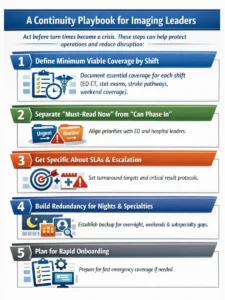
 

A continuity playbook for imaging leaders infographic with five steps: define minimum viable coverage by shift, separate must-read now from can phase in, set SLAs and escalation, build redundancy for nights/weekends/subspecialty reads, and plan rapid onboarding.

Hospitals are seeing pressure from multiple directions at once: staffing shortages, increasing exam complexity, heavier after-hours demand, and rising expectations for consistent turn times. One indicator the market is under strain: a Neiman Health Policy Institute analysis found that from 2014–2023, the number of practices with affiliated radiologists fell 14.7% while the number of radiologists grew 17.3%, reflecting ongoing consolidation and shifting coverage capacity.” When a group loses even a few radiologists—especially subspecialists—the coverage math can break quickly. Recruiting is rarely immediate, and internal coverage often becomes a patchwork of short-term fixes.


The important takeaway is this: a capacity disruption doesn’t require bad intent to create real clinical and operational risk. That’s why continuity planning matters.


A continuity playbook for imaging leaders

If you suspect your group is approaching a capacity shortfall, the best time to act is before turn times become a crisis. These steps can help protect operations and reduce disruption:

1) Define minimum viable coverage by shift

Document what must be covered on each shift to protect patient flow (e.g., ED CT, inpatient stat, stroke pathways, weekend coverage). This gives you a clear baseline if you need a stopgap plan.


2) Separate “must-read now” from “can phase in”

Not every study needs the same priority level. Align with ED and hospital leadership on what requires immediate final reads vs. what can be scheduled with acceptable delay.

3) Get specific about SLAs and escalation

If turn times are drifting, vague expectations won’t fix it. Define turnaround targets by priority category and document critical-result escalation pathways so the burden doesn’t land on one manager’s phone.

4) Build redundancy for nights, weekends, and subspecialty reads

Capacity collapses often reveal the weakest links first: overnight coverage, weekend staffing, and subspecialty depth. Even if you don’t outsource everything, having a backup partner for the riskiest windows can stabilize operations.

5) Plan for rapid onboarding before you need it

The fastest transitions happen when leadership has already identified what they’d need for an emergency coverage start: modality volumes, hours, PACS/RIS details, dictation preferences, and communication protocols.


How Vesta supports hospitals when coverage is strained or service is disrupted

When a radiology group can’t keep up, hospitals need dependable coverage that restores momentum—not another layer of complexity. Vesta Teleradiology helps facilities stabilize quickly with a continuity-first approach:

  • Scalable capacity to absorb surges and protect turn times
  • Subspecialty interpretation options aligned to case complexity
  • Clear expectations for turnaround and critical results communication
  • Rapid onboarding pathways designed for real hospital workflows

Whether you need temporary stabilization, overflow coverage, nights/weekends support, or a longer-term solution, we can tailor coverage so your imaging team isn’t forced into constant triage mode.


Every staffing disruption has context. The point isn’t to assign blame—it’s to protect continuity of care and keep clinical operations stable. If your facility is seeing warning signs of coverage strain, we can help you assess options and timelines without speculation about any third party.

Vizamyl’s New PET Label: Quantify & Monitor Amyloid—What It Means for Imaging Teams


What changed—and why it matters

The FDA has expanded the label for flutemetamol F 18 (Vizamyl), enabling quantification of amyloid plaque burden and long-term therapy monitoring in Alzheimer’s disease. This shift moves amyloid PET beyond a qualitative “positive/negative” decision toward objective, longitudinal assessment that can inform treatment choice, dose intervals, and discontinuation decisions. Business Wire

Professional groups report the update aligns amyloid PET with the clinical era of disease-modifying anti-amyloid therapies (e.g., lecanemab, donanemab), clarifying roles for baseline confirmation, on-treatment monitoring, and response tracking in routine care. Notably, SNMMI stated the FDA granted supplemental indications—including quantitative measurement and use for therapy monitoring—to three amyloid PET agents (flutemetamol F-18/Vizamyl, florbetapir F-18, and florbetaben F-18). SNMMI

Operational updates for radiology leaders

  • Protocols & quant pipelines: Build or validate a quant workflow (SUVr or comparable metrics) that’s scanner-calibrated and reproducible across sites. If you operate multi-vendor fleets, document harmonization steps in your SOPs.
  • Structured reports: Add fields for quantified burden at baseline, change from baseline, and interpretive guidance tied to therapeutic decisions (initiation, continuation, or discontinuation).
  • Scheduling & throughput: Expect rising referral volume from neurology and geriatrics as therapy monitoring enters routine practice; protect access with extended hours or overflow capacity.
  • Quality & governance: Define thresholds for biologically meaningful change, reader training for quant review, and reconciliation rules when quant and visual impressions diverge.

For additional context, trade coverage underscores that the updated label formally removes previous limitations around therapy monitoring and permits quant analysis in routine reporting. Empr

How Vesta Teleradiology helps

Vesta’s subspecialty neuro and nuclear medicine radiologists provide:

  • Amyloid PET expertise: Visual+quant reads with structured templates aligned to your therapy pathway.
  • Coverage when you need it: After-hours, weekends, or daytime overflow—without sacrificing turnaround time.
  • Interoperability: Seamless delivery to your PACS/RIS and EMR; clear flags for therapy decisions and recall intervals.
  • QA you can see: Peer review, consistency checks across readers, and optional double-reads during program ramp-up.

If you’re standing up or scaling amyloid PET services, we can supply immediate subspecialty coverage and templates tuned to your neurologists’ needs.


Rapid Hospital Onboarding by Vesta Radiology: A Case Study

Introduction In the fast-paced world of healthcare, disruptions in critical services can have far-reaching consequences on patient care and hospital operations. On December 31st, Vesta Radiology showcased its unparalleled responsiveness and expertise when Comanche County Medical Center faced an imminent lapse in radiology coverage. Within just five hours of the initial call, Vesta finalized an agreement, completed IT installation, and ensured uninterrupted radiology services by midnight. This blog explores the key aspects of this successful rapid onboarding and the invaluable role Vesta Radiology played in maintaining continuity of care.

The Challenge
On December 31st at 5:30 PM, Vesta Radiology received an urgent request from Comanche County Medical Center, whose existing radiology provider had unexpectedly ceased services. A planned onboarding with another radiology group had fallen through, leaving the hospital facing a critical gap in coverage. With only a few hours to act, the hospital urgently needed a solution to ensure patient care remained unaffected.


Vesta Radiology’s Response

Despite the tight deadline and high-pressure circumstances, Vesta Radiology swiftly mobilized its resources to deliver an effective solution. The rapid response involved the following key actions:

  1. Rapid Agreement Drafting:
    • Within minutes of the initial contact, Vesta’s legal and administrative teams collaborated to draft a tailored service agreement.
    • Leveraging pre-existing templates and streamlined approval processes, the agreement was finalized in record time.
  2. Immediate IT Installation:
    • Vesta’s IT team worked closely with the hospital’s technical staff to install and configure the necessary infrastructure, including PACS integration and secure communication channels.
    • Remote access was established, enabling seamless transmission of imaging data and reporting workflows.
    • The entire IT setup, which typically takes days, was completed in under five hours.
  3. Staff Deployment:
    • Vesta’s network of radiologists was promptly notified and scheduled to provide coverage starting at midnight.
    • Detailed onboarding materials and specific instructions ensured radiologists were fully prepared.
  4. Testing and Validation:
    • Rigorous testing of IT systems and workflows confirmed functionality and compatibility.
    • Communication protocols were validated to prevent disruptions during the initial hours of service.

Results
Thanks to Vesta Radiology’s rapid response and technical expertise, Comanche County Medical Center experienced zero downtime in radiology services. Coverage commenced precisely at midnight, ensuring patients continued to receive timely diagnoses and care. The hospital’s administration expressed profound gratitude for Vesta’s professionalism and swift action.

Key Takeaways
This case study highlights several strengths that distinguish Vesta Radiology as a trusted partner in the healthcare sector:

  • Agility: Vesta’s ability to rapidly deploy resources ensured seamless continuity of care.
  • Technical Excellence: The IT team’s efficiency in complex system setups demonstrated unparalleled expertise.
  • Client-Centric Approach: Vesta’s dedication to meeting urgent needs reinforces its commitment to client success.
  • Scalability: Vesta’s scalable processes allow it to handle time-sensitive requests without compromising service quality.

Conclusion Vesta Radiology’s successful onboarding of Comanche County Medical Center within five hours serves as a testament to its leadership in the radiology industry. By combining operational agility, technical proficiency, and a client-focused approach, Vesta ensures hospitals can rely on uninterrupted radiology services even in times of crisis.

Contact Us To learn more about how Vesta Radiology can support your medical center, hospital, or private practice, call us today or download our comprehensive case study for more insights.

Vesta Teleradiology

1071 S. Sun Dr. Suite 2001
Lake Mary, FL, 32746
Phone: 877-55-VESTA
Phone: 877-558-3782
Fax: 407-386-3358
Email: info@vestarad.com

New CMS-Approved MRI Standards: Enhancing Safety in Remote Scanning and Portable Imaging

The Centers for Medicare & Medicaid Services (CMS) has approved new MRI standards introduced by the Intersocietal Accreditation Commission (IAC), focusing on remote scanning and portable imaging technologies. These updates, effective immediately, aim to enhance patient safety and adapt to advancements in MRI practices.

Key Updates in MRI Standards

Remote Scanning Protocols: The revised standards mandate that a registered technologist must always be present with the patient during remote MRI scans. This ensures immediate care availability if needed. Facilities are also required to implement policies addressing potential challenges such as equipment or communication failures, internet instability, and power outages.

Portable MRI Scanning: The IAC has introduced standards for portable MRI technology, distinguishing it from mobile MRI units. This inclusion acknowledges the growing use of portable MRI devices in various healthcare settings and emphasizes the need for specific guidelines to ensure their safe and effective operation.

Contrast Administration and Supervision: Recognizing the challenges in meeting physician supervision requirements for contrast injections, the IAC has revised its policies to ensure a safe environment for patients. The new standards emphasize the presence of appropriately trained nonphysician personnel during contrast administration.


Implications for Healthcare Providers

These updates reflect the IAC’s commitment to quality improvement and patient safety in MRI services. Facilities must comply with the new standards to maintain accreditation, which may involve updating protocols, training staff, and investing in new technologies. The emphasis on remote scanning and portable MRI acknowledges the evolving landscape of medical imaging and the need for standards that keep pace with technological advancements.

Industry Response

The introduction of these standards has been met with support from industry stakeholders. For instance, Hyperfine, a manufacturer of portable MRI devices, noted that the new guidelines pave the way for their Swoop® Portable MR Imaging® system to be available in neurology offices and clinics. This development enables physicians to obtain diagnostic-quality MR brain images within their clinics, providing patients with timely and convenient MRI access at the point of care.


Conclusion

The CMS-approved MRI standards introduced by the IAC represent a significant step forward in ensuring patient safety and adapting to technological advancements in medical imaging. Healthcare providers are encouraged to familiarize themselves with these updates and implement the necessary changes to comply with the new accreditation requirements. As the medical imaging landscape continues to evolve, such proactive measures are essential to maintain high standards of care and patient safety.


Sources:
radiologybusiness.com
auntminnie.com
openai.com


What to Expect at RSNA 2024: A Sneak Peek at the AI Showcase

The RSNA 2024 Annual Meeting is right around the corner, and it’s shaping up to be a groundbreaking event for radiologists, medical professionals, and technology enthusiasts alike. Set to take place in Chicago, this year’s meeting will feature a diverse range of presentations, educational sessions, and networking opportunities. Among the many highlights, the AI Showcase promises to be a focal point for attendees interested in the cutting edge of artificial intelligence, machine learning, and deep learning technologies in healthcare.


The AI Showcase: A Hub of Innovation

Located in South Hall A of the Technical Exhibits, the AI Showcase is RSNA 2024’s premier destination for exploring the latest advancements in AI. This year, it will serve as the central hub for innovation, bringing together top industry leaders, researchers, and developers to present their newest products, solutions, and research in AI. Whether you’re looking to discover next-level AI software or gain insights from industry pioneers, the AI Showcase offers a dynamic environment to interact with the hottest topics in artificial intelligence today.


The RSNA 2024 Annual Meeting includes various highlights beyond the AI Showcase, such as educational sessions, plenary and special session speakers, technical exhibits, and hands-on workshops at RSNA Labs. The meeting also features social and networking events like the RSNA 5K Fun Run and RSNA After Dark, providing opportunities for attendees to connect and engage. Additionally, the event offers resources on navigating Chicago, transportation, onsite services, and hotel options.


For more details, visit the RSNA 2024 Meeting Central.


Sources:
rsna.org
Openai.com


How to Create a Comfortable Imaging Experience for Pediatric Patients  

Big machines, loud noises, unfamiliar people, funny smells. If you’ve had a medical image taken as an adult, you may not enjoy the experience, but you understand the process. As a child, it’s a totally different story. These factors may frighten or put them in a state of unease during a procedure that will help with their diagnosis or treatment. When it’s time for a little one to receive any medical imaging, there are a few things that can be done to help make them more comfortable and get the best result possible.


First and foremost, the best way to comfort a child before an imaging procedure is to keep them informed. If the child is old enough, of course, a parent, guardian, or medical professional can tell them what to expect during the procedure. Knowing what to wear, how it might feel, and how long it will take ahead of time will help the child feel in control of at least some parts of their day and reduce some stress.


For pediatric x-rays and MRIs, children often need to be in awkward positions to capture the correct image. This can be uncomfortable depending on the age of the child and the injury they have. Studies have shown that a negative experience occurs more often when a child is restrained. One technique that helps put a child more at ease is called comfort positioning. This technique involves positioning the child in a way that feels comforting for them, such as sitting on their parents’ lap or a comfortable chair or bed instead of the examining table. Positions like “tummy to tummy” or “back to chest” can also be used as a calming position with other distractions like a toy or a tablet. These positions help reduce the stress hormone and “minimize the physical symptoms associated with anxiety.” Studies have shown that giving children these options helps with cooperation and gives children more control during their procedures.


In some cases, a child may need to be sedated for the procedure. This can be scary for anyone, especially a child, where they need to stay still for long periods of time in a very tight space. Because of the nature of an MRI, the sound of the machine and the closed tightness, patients are not able to fully communicate their needs, and could therefore become easily anxious and begin to move. In cases like these, studies have shown that music, or the mother’s voice during the procedure may reduce the need for sedation and the amount of drugs needed to sedate.


To help children have a better experience during imaging, companies, such as Phillips, have designed equipment and educational programs to help as well. To prepare children for their scan, they have created the Scan Buddy App which features calming cartoon characters that lead them through the process with games and instruction. When children visit the location where they will get their scan, children are allowed to role play their scan with a “Kitten Scanner,” a child sized MRI machine where they can send stuffed animals through to see what will happen during the scan. In 2021, Phillips launched their pediatric coaching program, where lighting, visuals, and sounds are used to ease the stress of the child.


Calming techniques like these can help turn a very scary experience into one that a child is prepared for, relaxed for, and perhaps even pleasant. A calm child means good imaging results and better outcomes for treatment.


Errors in Radiology Interpretations in CT and MR imaging

In a recent study of 10,090 body CT scans, reviewed by attending physicians in the abdominal division, no significant difference in error rates was found between day and night studies. The study identified 44 errors in 2,164 day studies and 226 errors in 7,446 night studies. The research highlights that body CT studies often have higher error rates when interpreted by non-specialists due to the complexity of evaluating multiple organs. Specialists in body imaging, who reviewed the scans, often detected additional observations that generalists missed. To reduce errors, recommendations include using checklists, taking notes during reviews, making all observations before dictating, and thoroughly reviewing reports before finalizing them.


Additional Study

Research published in the Journal of the American College of Radiology highlights that up to 44% of diagnostic errors stem from improperly ordered laboratory tests and radiology exams. This issue is particularly significant for CT and MR imaging. A study led by Dr. Ariadne DeSimone at Brigham and Women’s Hospital found that implementing tailored order options and educational interventions significantly reduced these errors by 83%, from 16% to 3%. The study emphasizes the importance of improving the imaging order process to minimize diagnostic errors and enhance radiologists’ workflow by reducing time spent on correcting incorrect orders.


ChatGPT—Can it Reduce Errors?

chatgpt in interpretations
ChatGPT


A retrospective study explored the potential of ChatGPT-4 in assisting radiologists with error detection in radiology reports. The study involved 200 reports, with 150 common errors intentionally introduced. ChatGPT-4 identified 82.7% of errors, closely matching the performance of senior radiologists (89.3%) and surpassing assistants and residents (80.0%). Notably, ChatGPT-4 was significantly faster, taking just 3.5 seconds per report compared to 25.1 seconds for radiologists, and was more cost-effective. While promising, the study suggests that further prospective validation and specialized training are needed before widespread adoption of AI-assisted re-reading in radiology.


How Vesta can Help


Vesta is a leading teleradiology company offering comprehensive radiology support—partial, full, onsite or remotely. Our team of U.S. Board Certified radiologists encompasses various subspecialties, ensuring that interpretations are accurate and reliable, regardless of the complexity of the case. By leveraging our expertise and advanced technology, we provide seamless and precise radiology services, helping healthcare facilities enhance diagnostic accuracy and patient outcomes.


Sources:

Auntminnie.com
dotmed.com
Medscape.com
openai.com


Discover the Premier Event for Medical Imaging Professionals: AHRA’s 2024 Annual Meeting

Mark your calendars for August 4-7, 2024, as the AHRA (Association for Medical Imaging Management) hosts its much-anticipated Annual Meeting at the Orlando World Center Marriott in sunny Orlando, Florida. This premier event is designed for medical imaging management professionals, offering an unparalleled opportunity to learn, network, and grow within the industry.

What is the AHRA?

Founded in 1973, the AHRA is a professional organization representing the management sector of hospital imaging departments, freestanding imaging centers, and group practices. With over 5,000 members worldwide, the AHRA is dedicated to providing educational resources, professional development programs, networking opportunities, and certifications such as the Certified Radiology Administrator (CRA) credential.

Orlando
Orlando, Florida

Highlights of the 2024 Annual Meeting

Educational Sessions
The AHRA Annual Meeting is known for its comprehensive educational program. This year, attendees can look forward to a wide range of sessions, including workshops, panel discussions, and presentations by industry experts. Topics will cover the latest innovations in medical imaging technology, best practices in management, and strategies for improving patient care. Whether you are a seasoned professional or new to the field, there will be sessions tailored to your needs.

Networking Opportunities

Networking is a cornerstone of the AHRA Annual Meeting. Attendees will have numerous opportunities to connect with peers, industry leaders, and exhibitors. These interactions are invaluable for building professional relationships and exchanging ideas. The meeting fosters a collaborative environment where attendees can discuss challenges, share solutions, and gain insights from each other​

Special Events

One of the highlights of the Annual Meeting is the AHRA Closing Party. This year’s theme, “Flock to Florida,” invites attendees to dress in their best beachy “Margaritaville” attire. It’s a fun and relaxed way to wrap up several days of intense learning and networking, providing a chance to unwind and celebrate with colleagues​.

Exhibits and Sponsors

The exhibition hall will feature leading vendors showcasing the latest products and services in the medical imaging industry. This is an excellent opportunity to see new technologies in action, ask questions, and learn how these innovations can be implemented in your practice.

Workshops and Hands-on Training
The meeting includes specialized workshops, such as the CRA Exam Workshop, designed to help attendees prepare for certification and gain hands-on experience with new technologies and techniques. These sessions are invaluable for anyone looking to enhance their skills and advance their career​

Notable Talks

The Employment Continuum (Part 1 & Part 2): These sessions, led by Brenda DeBastiani, will cover strategies for recruiting, interviewing, hiring, coaching, and retaining talent in imaging departments, with a focus on creating a seamless succession of career development​.

Introduction to Regulatory & Compliance: Cindy Winter will introduce participants to the complex landscape of regulatory requirements and compliance, including recent changes and their impact on imaging services​
Marketing Matters: Building Basics: This session will delve into effective marketing strategies for radiology departments and imaging centers, emphasizing both internal and external marketing plans​.
Managerial Communication: Brenda DeBastiani will also lead this session on improving communication skills in the workplace, focusing on both verbal and non-verbal communication, listening skills, and persuasive techniques​.

Washington Update: The Latest Developments in Healthcare Policy: Nathan Baugh will provide insights into current and upcoming healthcare policies, including Medicare reforms, price transparency measures, and telehealth​.

Meet Vesta at Booth 309!

We are excited to announce that we will be exhibiting at the AHRA 2024 Annual Meeting in Orlando from August 4-7. Visit us at our booth to learn more about our advanced teleradiology services. Our team will be showcasing how our innovative solutions can enhance radiology operations, improve diagnostic accuracy, and streamline workflows through cutting-edge technology and comprehensive support.

We look forward to connecting with industry professionals and discussing how our teleradiology services can meet your needs. See you in Orlando!

AHRA 2024


Sources:

Ahra.org
Openai.com

How Mobile Radiology Companies Can Enhance their Operations with Teleradiology

Mobile radiology companies play a vital role in modern healthcare by bringing diagnostic imaging services directly to patients, whether at home, in nursing facilities, or at remote medical clinics. These mobile units provide convenient access to critical medical tests, often eliminating the need for patients to travel to traditional imaging centers. The U.S. mobile imaging services market was valued at approximately USD 5.3 billion in 2022 and is expected to continue growing significantly.

However, to ensure accurate and timely diagnosis, mobile radiology companies frequently rely on teleradiology services for expert interpretation and analysis of imaging studies. This partnership between mobile radiology and teleradiology companies not only enhances diagnostic capabilities but also streamlines operational efficiency, ensuring that patients receive prompt and reliable medical care. We will explore the benefits of such collaborations, highlighting how they contribute to improved patient outcomes and service delivery in healthcare settings.

Teleradiology offers several benefits to mobile radiology companies, enhancing their operational efficiency and service delivery.

Here are some key benefits supported by studies and industry insights:

Increased Accessibility and Flexibility: Teleradiology enables radiologists to remotely interpret images from various locations, including mobile units and remote sites. This flexibility improves access to radiological expertise, particularly in underserved or remote areas.

Improved Turnaround Times: Studies indicate that teleradiology can significantly reduce turnaround times for reporting and diagnosis. Rapid transmission of images and prompt reporting enhance patient care by accelerating diagnosis and treatment decisions.


imaging interpretation
Radiologist reviews an x-ray

Cost Efficiency: Mobile radiology companies can achieve cost savings through teleradiology by optimizing resource allocation and reducing the need for onsite radiologists. This model minimizes operational expenses while maintaining quality and accessibility.

Scalability and Service Expansion: Teleradiology supports scalability for mobile radiology services, allowing companies to expand their geographic reach and service offerings without geographical constraints. This scalability facilitates broader healthcare access and patient outcomes.

Quality Assurance and Collaboration: Remote consultations and second opinions facilitated by teleradiology promote collaboration among radiologists. This enhances diagnostic accuracy, reduces errors, and ensures quality assurance through peer review and consultations.


Vesta Teleradiology: Mobile Radiology Support

As a leading teleradiology provider, we support mobile radiology companies with comprehensive, accurate interpretations by US board-certified radiologists. Our experts cover a wide range of subspecialties, including musculoskeletal, neuroimaging, pediatric, cardiac, and emergency radiology. We ensure timely, reliable diagnostics, improving patient care and expanding service reach. Trust us to enhance your operations with structured reporting, standardized protocols, and continuous education. Partner with us for seamless integration and exceptional radiology services. Contact us for more information on how we can support your mobile radiology needs.


Sources:

gminsights.com
ncbi.nlm.nih.gov
openail.com


An Update to the Physician Shortage Problem

The AAMC (Association of American Medical Colleges) has released new projections indicating a physician shortage of up to 86,000 physicians in the United States by 2036. This underscores the critical need for sustained and increased investments in training new physicians to address the country’s healthcare needs. The report, conducted by GlobalData Plc, includes various scenarios based on trends in healthcare delivery and the workforce. While the projected shortfall is smaller than previous estimates, it still highlights the necessity for additional investments in graduate medical education (GME). Demographics, particularly population growth and aging, are driving the increasing demand for physicians. The report also notes a significant portion of the physician workforce nearing retirement age, which will further decrease the physician supply. Addressing underserved communities could require approximately 202,800 more physicians than current estimates. Lifting the federal cap on Medicare support for GME and bipartisan legislation like the Resident Physician Shortage Reduction Act aim to alleviate the shortage, but further efforts are needed to meet future healthcare demands.


Rural Americans’ Healthcare Challenges

Rural Americans face significant healthcare challenges, with fewer available doctors compared to urban areas, exacerbating existing health issues. Dr. Bruce A. Scott, President of the American Medical Association, emphasizes the urgent need for policymakers to address these disparities. Rural communities experience higher rates of various illnesses, exacerbated by economic pressures and limited access to healthy living conditions. The shortage of specialists and the closure of rural hospitals further compound the problem. Insufficient access to primary care physicians is a pressing issue, with inadequate residency spots and decreasing applications from rural areas. The AMA advocates for changes to the Medicare physician payment system, which has seen a decline in rates over the years. Administrative burdens, such as prior authorizations, are also contributing to physician burnout and compromising patient care. To combat the doctor shortage and rural health challenges, the AMA advocates for healthcare reforms, including overhauling the Medicare payment system, expanding telehealth, increasing residency positions, incentivizing rural practice, and addressing workforce stresses.

hospitals in rural America

Radiology Is Being Hit, Too

Radiology departments are grappling with worsening staffing shortages alongside declining reimbursements. During the RSNA 2023 meeting, Ashish Sant from Merge by Merative discussed key trends and challenges. Staffing and cost management remain top concerns due to burnout and insufficient replacements for retiring radiologists. To address these issues, there’s a push towards cloud-based solutions, with a modular approach easing concerns about data security and patient information management. The pandemic has accelerated the shift towards cloud adoption, highlighting benefits such as accessibility and cost reduction. Integrating AI into radiology workflows is another focus, though challenges persist in seamlessly embedding AI solutions. Merge’s partnership with Microsoft Azure aims to provide customers with cloud solutions tailored to their needs.


Radiology Support for the US

Addressing radiology staffing shortages is crucial for ensuring efficient and effective healthcare delivery. Whether you’re a hospital, outpatient center, or part of the Indian Health Service (IHS), Vesta is here to help. Our team can provide on-site radiologists or teleradiologists to meet the specific needs of your facility. By partnering with us, you can ensure timely and accurate radiology services, ultimately improving patient care and outcomes. Don’t let staffing shortages hinder your operations – reach out today to learn how we can support your radiology department.


Sources:

Aamc.org
dtnpf.com
Healthimaging.com
openai.com